


LGBT Forced Marriage
LGBT Forced Marriage
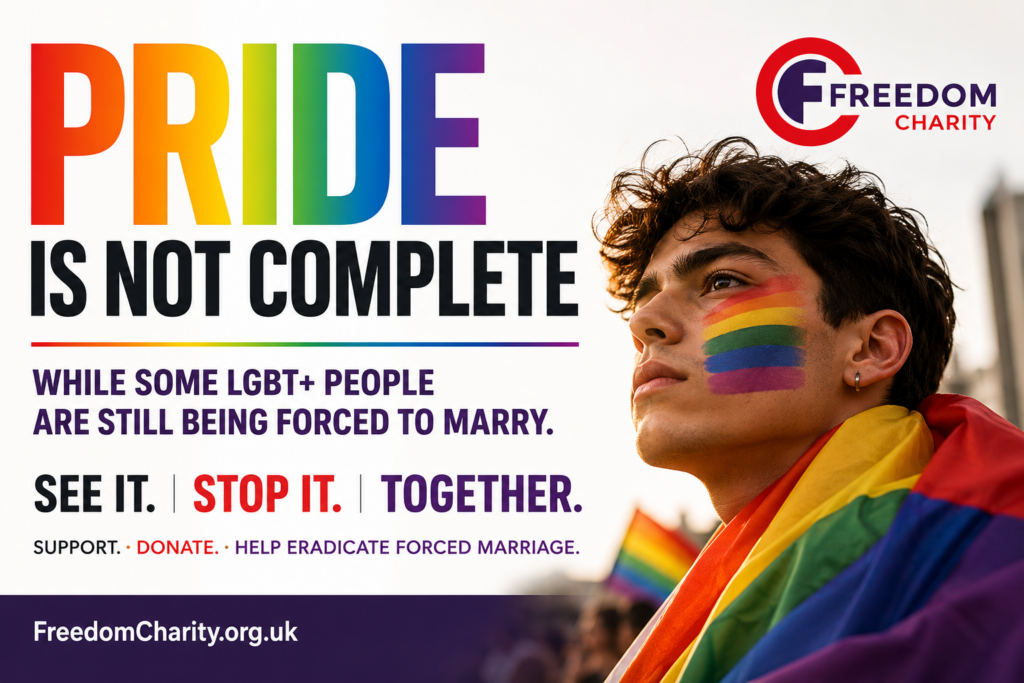
Pride Is Not Complete: The Hidden Reality of LGBT Forced Marriage
Freedom believe
Yes. Gay, bisexual, lesbian and other LGBT+ people can be forced into marriage. Some face pressure, threats, coercion or abuse from family members who want to hide their sexuality, protect family reputation or enforce social, cultural or religious expectations. In the United Kingdom, forced marriage is illegal. LGBT forced marriage is a safeguarding issue, a human rights abuse and a denial of personal freedom.
Every June, Pride celebrates visibility, dignity and the freedom to be yourself.
Rainbow flags appear in schools, workplaces, public buildings and city centres. Millions of people come together to celebrate progress. Moreover, Pride gives many LGBT+ people a sense of belonging, acceptance and hope.
However, Pride does not tell the whole story.
While many people can live openly and safely, others still face intense pressure behind closed doors. Some hide who they are because they fear rejection. Others worry about losing their home, financial support or community connections. In the most serious cases, families pressure people to marry someone they do not choose.
For those individuals, Pride is not only a celebration. It is also a reminder of a freedom they still do not fully have.
Why this issue matters
Forced marriage affects women and girls. Yet it also affects men and boys. Furthermore, it can affect gay, bisexual, lesbian and transgender people whose sexuality or identity conflicts with family expectations.
Despite this, public discussion often overlooks LGBT+ victims.
That lack of awareness matters. When professionals miss the warning signs, victims may not receive help. When communities refuse to discuss the issue, victims can become isolated. Equally important, when policymakers lack reliable information, services struggle to understand the true scale of the problem.
Official UK data confirms that forced marriage remains a live safeguarding issue. The Forced Marriage Unit recorded 1,295 contacts relating to possible forced marriage and/or female genital mutilation in 2025. This included 406 cases where tailored assistance was provided.
Men accounted for more than a quarter of those assisted. However, current public statistics do not clearly reveal the full extent of LGBT forced marriage. Older government data has identified LGBT+ victims, which shows the issue is real but still under-recognised.
This guide explains what LGBT forced marriage is, why it happens, why it often remains hidden and what professionals, families, communities and policymakers can do to prevent it.
Most importantly, it starts from a simple principle.
Every person has the right to choose if, when and whom they marry.
That principle does not change because of sexuality, family pressure, culture, religion or reputation. Without choice, there is no freedom. Without freedom, there is no genuine consent.
What is LGBT forced marriage?
LGBT forced marriage occurs when a lesbian, gay, bisexual, transgender or other LGBT+ person faces pressure, threats or coercion to enter a marriage against their free will.
Importantly, an arranged marriage is not the same as a forced marriage. In an arranged marriage, both people remain free to refuse. In a forced marriage, that freedom disappears.
The law focuses on consent. Therefore, the key question is simple: can the person genuinely choose?
When the answer is no, safeguarding concerns arise.
How coercion can work
Coercion takes many forms. Sometimes families use emotional pressure. In other cases, relatives threaten to withdraw financial support, housing or contact with loved ones.
Some victims face intimidation, violence, monitoring of their movements or threats of being taken abroad.
For LGBT+ people, additional pressures can exist. A young person may fear rejection because of their sexuality. Another may fear losing their family entirely. Others worry about becoming isolated from the community they have known throughout their lives.
As a result, LGBT forced marriage often remains hidden.
Many victims feel unable to disclose what is happening because doing so may also reveal their sexuality or gender identity. Consequently, professionals may not recognise the warning signs until the situation reaches crisis point.
The right to choose if, when and whom to marry is a fundamental human right. That principle applies equally to gay people, bisexual people, lesbian people, transgender people and heterosexual people.
No family, community or institution should take that choice away.
Can gay men be forced into marriage?
Yes. Gay and bisexual men can be forced, pressured or manipulated into marrying women.
This can happen when family members believe marriage will hide sexuality, protect reputation or reduce community shame. In some cases, relatives may think marriage will change a man’s sexual orientation.
However, sexuality is not an illness. Marriage cannot “cure” someone of being gay or bisexual.
This belief can cause serious harm.
A man may feel he has no safe way to refuse. He may fear rejection, violence, homelessness or complete isolation from his family. In addition, he may worry that asking for help will expose his sexuality before he feels safe to disclose it.
Consequently, gay and bisexual men can become invisible in forced marriage discussions.
Why professionals must see male victims
Many people still wrongly assume that forced marriage only affects women and girls. That assumption leaves men and boys at risk. It also stops professionals asking the right questions.
A gay man forced into marriage loses the right to make one of the most personal decisions of his life.
Yet he may not be the only person harmed.
The woman he marries may also lose the chance to enter a relationship based on honesty, trust and genuine consent. She may believe she is entering a marriage freely, while the man has entered it under pressure or fear.
As a result, LGBT forced marriage can harm more than one person. It can harm the person being coerced, the spouse, future children and wider families.
This is why the issue cannot sit only inside LGBT+ policy. It belongs in safeguarding. It belongs in women’s rights. Above all, it belongs in every serious conversation about forced marriage.
Why some families believe marriage will “cure” sexuality
Some families pressure LGBT+ people into marriage because they wrongly believe marriage will change sexual orientation or gender identity.
This belief is false.
Sexuality is not an illness. Gender identity is not a shameful secret. Therefore, marriage must never be used as a way to “fix”, hide or punish someone.
During safeguarding work, Aneeta Prem MBE has encountered deeply harmful beliefs about sexuality and marriage. On one occasion, an imam told her that if a gay man married a woman, he would be “cured”.
That statement was shocking.
It also shows why this issue needs careful public discussion.
When belief becomes safeguarding risk
The concern is not faith itself. Many people of faith reject abuse and support the right to safety.
However, when anyone uses religion, culture, family honour or community pressure to force someone into marriage, the issue becomes safeguarding.
A young person may hear these messages and feel trapped. They may believe they have no right to refuse. In addition, they may fear that saying no will lead to rejection, violence or isolation.
As a result, some LGBT+ people may agree to a marriage outwardly while feeling terrified inside.
Consent given under fear is not free consent.
Marriage should be based on choice, honesty and dignity. It should never be used as a tool of control.
The hidden victim nobody talks about
When a gay or bisexual man is forced into marriage with a woman, there may be more than one victim.
The man loses the right to choose his own life.
The woman may also lose the chance to enter a marriage based on honesty, trust and full consent.
This matters.
Too often, public discussion treats forced marriage as if it affects only the person being pushed into the wedding. However, a coerced marriage can affect everyone inside it. It can affect the spouse, children and wider families who live with secrecy, pressure and fear.
A woman may enter the marriage believing both people have chosen it freely. Yet, in reality, the man may have agreed because family members threatened him, controlled him or told him that marriage would “fix” him.
As a result, both people may become trapped in a life shaped by fear rather than truth.
This does not mean the gay or bisexual man is to blame. The responsibility sits with those who created the coercion.
However, it does show why LGBT forced marriage is also a women’s rights issue.
Why stereotypes create danger
A forced marriage can deny one person the right to live openly. At the same time, it can deny another person the right to build a relationship based on honesty.
Therefore, professionals must look beyond stereotypes.
Forced marriage is not only about girls being taken abroad. It is not only about one community. It is not only about one religion.
It can also involve men who fear exposure, women who do not know the full truth, families who prioritise reputation over consent and communities that reward silence.
The harm can last for years. For some, it can last a lifetime.
What do the UK figures show?
Official UK data confirms that forced marriage remains a live safeguarding issue.
In 2025, the Forced Marriage Unit received 1,295 contacts linked to possible forced marriage and/or female genital mutilation. This included 406 cases where the FMU provided tailored assistance. The remaining contacts involved enquiries that required advice or signposting.
The figures also show that forced marriage does not only affect women and girls. In 2025, 74% of cases involved female victims, which means 26% involved male victims.
That matters because too many people still see forced marriage only through one lens.
However, the current public statistics do not clearly show the full picture for LGBT+ victims. The FMU publishes data on sex, age, disability, mental capacity, region and country focus, but current public reporting does not give a detailed breakdown by sexual orientation or gender identity.
What the older LGBT+ data shows
Older UK data shows why this gap matters.
In 2020, the FMU reported 19 cases involving LGBT+ victims. That represented 3% of cases. The same report stated that male victims were particularly represented in LGBT+ forced marriage cases, with 63% of those cases involving male victims.
Therefore, LGBT forced marriage is not theoretical. The UK has already recorded it. The problem is that public data still does not show its true scale.
This creates a serious risk.
When professionals do not see LGBT+ people in the data, they may not see them in real life. If schools, police, social workers and health professionals do not ask the right questions, victims may remain hidden until the risk becomes severe.
Galop, the LGBT+ anti-abuse charity, also recognises forced marriage as a form of honour-based abuse affecting LGBT+ people. Galop states that families and communities can use forced marriage to control a person’s sexuality or gender identity.
This evidence points to one clear conclusion.
LGBT forced marriage exists. It has appeared in official UK data. Specialist LGBT+ abuse services recognise it. Yet public understanding remains far behind the risk.
The absence of full statistics is not evidence of absence. It is a warning that some victims may still be missing from the systems meant to protect them.
Why LGBT forced marriage is under-reported
LGBT forced marriage is likely to be under-reported because victims often face more than one fear at the same time.
They may fear the marriage. They may also fear being outed. Together, those fears can make disclosure extremely difficult.
A young person may know that marriage is wrong for them. However, asking for help may mean telling a teacher, police officer, doctor or social worker about their sexuality before they feel safe to do so.
As a result, silence can feel safer than disclosure.
Family pressure can also make reporting harder. Some victims depend on relatives for housing, money, education, immigration support or care. In addition, they may love their family and fear losing them completely.
Others may worry that professionals will not understand the risk.
For example, a professional may ask: “Why don’t you just say no?”
That question misunderstands coercion.
Why “just say no” is not enough
A person facing forced marriage may not feel free to say no. They may fear violence, rejection, homelessness, emotional blackmail, removal from education, loss of contact with siblings or being taken abroad.
Consequently, LGBT+ victims may remain hidden until the risk becomes severe.
This is why professionals must ask careful questions and avoid assumptions.
They should not assume every engagement is wanted. Nor should they assume only girls face forced marriage. They must also avoid assuming LGBT+ people are safe because they live in the UK.
Above all, professionals should never treat silence as consent.
In safeguarding, the absence of disclosure does not always mean the absence of harm. Sometimes, it means the person does not yet feel safe enough to speak.
Is this about religion?
This article is not an attack on faith, culture or community.
Forced marriage is not confined to one religion, one ethnicity or one country. It can happen in different communities, including communities with no religious basis at all.
However, religion, culture, family honour or community reputation can sometimes be misused to justify coercion.
That is where safeguarding concerns begin.
Many people of faith reject abuse. Many parents want their children to live safely and with dignity. Moreover, many community leaders understand that marriage without free consent causes serious harm.
Yet some individuals still use belief, shame or reputation as a weapon.
They may tell a young person that being gay or bisexual brings dishonour. Others may claim that marriage will solve the problem. Some may insist that refusal will shame the family.
In practice, those messages can trap someone.
Freedom Charity’s position is clear.
The issue is not belief. The issue is coercion, control and forced marriage.
No one should use faith, family or tradition to remove another person’s right to choose if, when and whom they marry.
Global perspectives and human rights
LGBT forced marriage is not only a UK safeguarding issue. It also sits within a wider global human rights context.
In some countries, LGBT+ people face criminalisation, violence or severe discrimination. In those circumstances, a person may fear exposure not only within their family, but also within society and the legal system.
ILGA World reported in June 2026 that 65 UN member states criminalise consensual same-sex sexual acts. It also reported that the death penalty is legally prescribed in seven UN member states, with uncertainty in five more.
This global context matters because some victims may fear being taken abroad, exposed to unsafe environments or forced into marriage in another country.
However, LGBT forced marriage can also happen in countries where same-sex relationships are legal.
Legal protection does not always remove family control.
A young person may live in the UK and still face threats inside the home. A student may attend university and still fear being taken abroad during the holidays. An adult may have legal rights and still feel unable to challenge relatives who control money, housing or community access.
Therefore, professionals must avoid false reassurance.
They should not assume that a person is safe because they live in a country with LGBT+ rights. They should not assume that adulthood removes risk. They should not assume that a person is safe because they have not directly asked for help.
Human rights begin with freedom, dignity and consent.
Forced marriage violates all three.
Warning signs of LGBT forced marriage
LGBT forced marriage may not always look obvious.
Sometimes, the warning signs appear slowly. At other times, risk escalates quickly after a person discloses, or is suspected of being, gay, bisexual, lesbian or trans.
Schools, colleges, universities, police, health services and community organisations should look for patterns rather than one single sign.
Possible warning signs include:
Sudden talk of engagement or marriage.
Fear after discussions about sexuality or identity.
Withdrawal from school, college, university or work.
Unexplained overseas travel or concern about a family trip.
Loss of contact with friends or trusted adults.
Family members controlling phones, money or movement.
Sudden restrictions on clothing, social life or relationships.
Threats linked to shame, dishonour or family reputation.
Pressure to end a same-sex relationship.
A person saying they feel trapped, unsafe or unable to refuse.
A sudden change in mood, attendance or behaviour.
One warning sign may not prove forced marriage. However, several signs together should raise concern.
Professionals should listen carefully. They should avoid judgement. They should not contact the family without specialist safeguarding advice, because that can increase risk.
Most importantly, they should remember that silence does not always mean safety. Sometimes, silence means fear.
What schools need to know
Schools may be the first safe place where a young person shows signs of LGBT forced marriage risk.
A pupil may not use the words “forced marriage”. They may say they feel frightened, trapped or unable to talk at home. They may also become withdrawn, miss lessons or suddenly mention an engagement, wedding or overseas trip.
Therefore, schools should treat sudden changes seriously.
Staff should never assume that forced marriage only affects girls. They should also avoid assuming that LGBT+ pupils are safe because the school has equality policies. Those policies matter, but they do not remove risk inside the home.
How schools should respond
In practice, schools should:
Listen without judgement.
Record concerns clearly.
Follow safeguarding procedures.
Seek specialist advice where needed.
Avoid contacting the family if doing so could increase risk.
Consider whether sexuality, identity, family pressure and marriage risk may be connected.
Schools should also use education to prevent harm before crisis point.
Books, assemblies, PSHE lessons and safeguarding training can help pupils understand consent, coercion and the right to choose. In addition, they can help young people recognise that love, family and culture should never remove personal freedom.
A school that understands LGBT forced marriage may see a risk that another professional misses.
That can change the course of a young person’s life.
What universities need to know
Universities also need to understand LGBT forced marriage.
A student may appear independent, but still face intense family control. They may rely on relatives for money, housing, immigration support or emotional connection. Therefore, university staff should not assume that adulthood removes risk.
Some students may face pressure during holidays, especially before overseas travel. Others may return from home visits distressed, withdrawn or suddenly engaged.
In addition, LGBT+ students may fear that seeking help will expose their sexuality or gender identity to family members. That fear can make disclosure harder.
Warning signs for universities
Universities should train staff to recognise possible signs of forced marriage, including:
Sudden withdrawal from studies.
Missed lectures or placements.
An unexpected engagement or wedding plan.
Fear about going home during holidays.
Loss of contact with friends or tutors.
Family members speaking on behalf of the student.
Distress after conversations about sexuality, identity or relationships.
Universities should respond with care.
They should speak to the student privately, record concerns and follow safeguarding procedures. Moreover, they should seek specialist advice before any contact with family members.
A student at risk may not say everything at once. However, one safe conversation can make it easier for them to ask for help later.
What professionals need to know
Professionals must recognise LGBT forced marriage as a safeguarding risk.
This includes teachers, university staff, police officers, social workers, doctors, nurses, counsellors, youth workers, housing officers and immigration advisers.
In practice, professionals should avoid narrow assumptions. Forced marriage can affect women and girls, but it can also affect men, boys and LGBT+ people. It can involve overseas travel, but it can also happen entirely within the UK.
Professionals should ask careful, private and non-judgemental questions.
For example:
“Do you feel under pressure to marry?”
“Can you safely say no?”
“Are you worried about what may happen if your family finds out about your relationship or identity?”
“Has anyone threatened you, controlled you or taken your documents?”
“Are you worried about being taken abroad?”
These questions can open a safer conversation.
However, professionals must not rush to contact family members. That can increase risk, especially if the family is involved in the coercion.
Instead, they should follow safeguarding procedures, record concerns clearly and seek specialist advice.
Above all, professionals should remember this:
A person does not need to be physically dragged to a wedding for forced marriage to exist.
Fear, pressure, threats, control and loss of genuine choice can be enough to create serious risk.
Why Pride must include those who cannot safely be visible
For many people, Pride is a celebration of visibility, dignity and safety.
Yet not everyone can safely attend a Pride event, display a rainbow flag or tell their family who they are.
Some LGBT+ people still live with fear at home. Rejection, violence, isolation and forced marriage remain real risks for those whose families refuse to accept their sexuality or identity.
That is why Pride should not focus only on those who can be seen. It must also recognise people who remain hidden.
Pride and hidden risk
A young person may be unable to come out safely.
A student may fear going home during the holidays.
An adult may live under family control while appearing independent to the outside world.
In each case, the public image of freedom may hide private coercion.
Freedom must mean choice
Real freedom means more than visibility.
It means choosing who you love.
It means deciding if, when and whom you marry.
It also means living without threats, shame or family pressure.
For this reason, Pride Month provides an important opportunity to discuss LGBT forced marriage. It can help schools, professionals, policymakers and communities recognise a form of abuse that often remains hidden.
Pride is not complete while some LGBT+ people are still forced to choose between identity, safety and family.
Pride is not complete while some LGBT+ people are still being forced to marry.
How Freedom Charity can help
Freedom Charity works to prevent forced marriage through education, safeguarding awareness and early intervention.
Forced marriage does not always look the same. It can affect girls and women, but it can also affect boys, men and LGBT+ people.
When services fail to recognise the full range of victims, people stay hidden.
Education and prevention
Freedom Charity can raise awareness of LGBT forced marriage in schools, colleges, universities and professional settings.
The charity can also support safer conversations about consent, coercion, family pressure and the right to choose.
Freedom Charity’s book But It’s Not Fair helps young people and professionals understand forced marriage, family control and free consent. It opens discussion in a way that is accessible, age-appropriate and rooted in safeguarding.
Training and early recognition
Professionals need confidence to recognise risk earlier.
Training should cover warning signs, safe responses, referral routes and the importance of not contacting families where doing so could increase danger.
Freedom Charity’s message is clear.
No one should be forced to marry.
No one should be forced to hide who they are.
No one should lose safety because of sexuality, family pressure or fear.
By supporting this work, donors, schools, Pride organisations and safeguarding partners can help Freedom Charity reach people who may not yet know where to turn.
What needs to change?
Awareness of forced marriage has improved in recent years. However, significant gaps remain.
LGBT forced marriage still receives limited public attention. Consequently, many victims remain invisible. Moreover, many professionals receive little or no training on how sexuality, identity and forced marriage can intersect.
That needs to change.
Better data
The UK needs better data.
Current public statistics do not fully show the scale of LGBT forced marriage. Therefore, policymakers, researchers and safeguarding organisations cannot accurately measure the problem or identify trends.
Better training
Schools, colleges and universities need clearer training on LGBT forced marriage.
Many professionals understand forced marriage in general. However, fewer understand how family pressure linked to sexuality or gender identity can increase risk.
Better safeguarding guidance
Safeguarding guidance should recognise LGBT forced marriage more explicitly.
Professionals need confidence to ask sensitive questions, recognise warning signs and respond safely.
Better public understanding
Communities need open and honest conversations.
Silence protects abuse. By contrast, education helps people recognise risk earlier and seek help sooner.
Survivors and those with lived experience must also shape the response. Their experiences can improve policy, training and prevention.
Real change begins when people acknowledge a problem that many would rather ignore.
LGBT forced marriage is a safeguarding issue.
It is a human rights issue.
It deserves greater visibility, stronger protection and urgent action.
Final message
Pride is about freedom. However, freedom cannot belong only to those who are safe enough to be visible.
It must reach the person hiding a relationship because they fear violence.
It must protect the student afraid to go home during the holidays.
It must challenge the belief that marriage can “cure” a gay person.
It must also recognise the woman who may enter a marriage shaped by secrecy rather than truth.
Above all, it must reach every person trapped between family, identity and safety.
LGBT forced marriage is not a marginal issue. It is a hidden form of coercion at the intersection of safeguarding, human rights, women’s rights and LGBT+ equality.
The principle is simple.
Every person has the right to choose if, when and whom they marry.
That right does not disappear because of sexuality, culture, religion or family pressure.
Marriage without free consent is not protection.
It is not tradition.
It is not love.
It is abuse.
Freedom Charity believes Pride is not complete while some LGBT+ people are still being forced to marry.
See it. Stop it. Together.
Frequently asked questions
Can gay people be forced into marriage?
Yes. Gay, bisexual, lesbian and other LGBT+ people can be forced, pressured or coerced into marriage. Families may use marriage to hide sexuality, protect reputation or force someone to conform. This is abuse.
Is forced marriage illegal in the UK?
Yes. Forced marriage is illegal in the UK. GOV.UK describes forced marriage as a form of domestic abuse and a serious abuse of human rights.
Is arranged marriage the same as forced marriage?
No. In an arranged marriage, both people can freely refuse. In a forced marriage, one or both people do not consent, or they cannot consent freely because of pressure, threats or abuse.
Can men and boys be victims of forced marriage?
Yes. Men and boys can be victims. The 2025 FMU statistics show that 26% of cases where tailored assistance was provided involved male victims.
Why might LGBT+ victims not report forced marriage?
Many fear being outed, rejected, made homeless or taken abroad. Others depend on relatives for money, housing, education or immigration support. Consequently, many victims stay silent until risk becomes severe.
What should professionals do if they suspect forced marriage?
Professionals should listen, record concerns, follow safeguarding procedures and seek specialist advice. They should not contact the family without advice, because this can increase risk.
Why is Pride Month relevant to forced marriage?
Pride celebrates freedom, dignity and visibility. However, some LGBT+ people cannot safely be visible because they face family control, threats or pressure to marry. Pride must include those still denied freedom.
How can Freedom Charity help?
Freedom Charity works through education, safeguarding awareness, prevention and professional training. Its work helps schools, professionals and young people understand forced marriage, coercion, consent and the right to choose.
Sources and further reading
GOV.UK, Forced Marriage Unit statistics 2025:
https://www.gov.uk/government/statistics/forced-marriage-unit-statistics-2025/forced-marriage-unit-statistics-2025
GOV.UK, Forced marriage guidance:
https://www.gov.uk/guidance/forced-marriage
GOV.UK, Forced Marriage Unit statistics 2020:
https://www.gov.uk/government/statistics/forced-marriage-unit-statistics-2020/forced-marriage-unit-statistics-2020
Galop, Forced marriage:
https://www.galop.org.uk/forced-marriage
Galop, Honour-based abuse:
https://www.galop.org.uk/honour-based-abuse
ILGA World, Pride Month 2026 data:
https://ilga.org/news/pride-month-2026-lgbti-maps-data/
ILGA World Database, Criminalisation of consensual same-sex sexual acts:
https://database.ilga.org/criminalisation-consensual-same-sex-sexual-acts
GOV.UK, What is forced marriage? Easy-read guidance:
https://assets.publishing.service.gov.uk/media/641aef318fa8f547c68029fc/WhatIsForcedMarriage_V3_15-03-23_.pdf
Author box
Aneeta Prem MBE is the founder of Freedom Charity and the author of But It’s Not Fair and Cut Flowers. She has worked nationally on forced marriage, dishonour abuse, safeguarding, education and the protection of children and young people. Freedom Charity works to prevent abuse through education, awareness, professional training and early intervention.
Aneeta Prem 6th June 2026 London
- Freedom Charity homepage
https://freedomcharity.org.uk/ - Forced Marriage page
https://freedomcharity.org.uk/forced-marriage/ - Helpline page
https://freedomcharity.org.uk/helpline/ - Contact Freedom Charity
https://freedomcharity.org.uk/contact-us/ - Donate to Freedom Charity
https://freedomcharity.org.uk/donate-to-freedom-charity-protect-children-from-forced-marriage-and-fgm/ - Why Donate to Freedom Charity
https://freedomcharity.org.uk/why-donate-to-freedom-charity/ - But It’s Not Fair book page
https://freedomcharity.org.uk/but-its-not-fair-forced-marriage-book/ - PSHE Educational Resources
https://freedomcharity.org.uk/pshe-educational-resources/ - PSHE-Accredited Forced Marriage and FGM Lesson Plans
https://freedomcharity.org.uk/pshe-accredited-forced-marriage-and-fgm-lesson-plans/ - Forced Marriage and FGM Books for Schools
https://freedomcharity.org.uk/forced-marriage-and-fgm-books-for-schools/ - Schools page
https://freedomcharity.org.uk/schools/ - Fundraise for Freedom Charity
https://freedomcharity.org.uk/fundraise/