



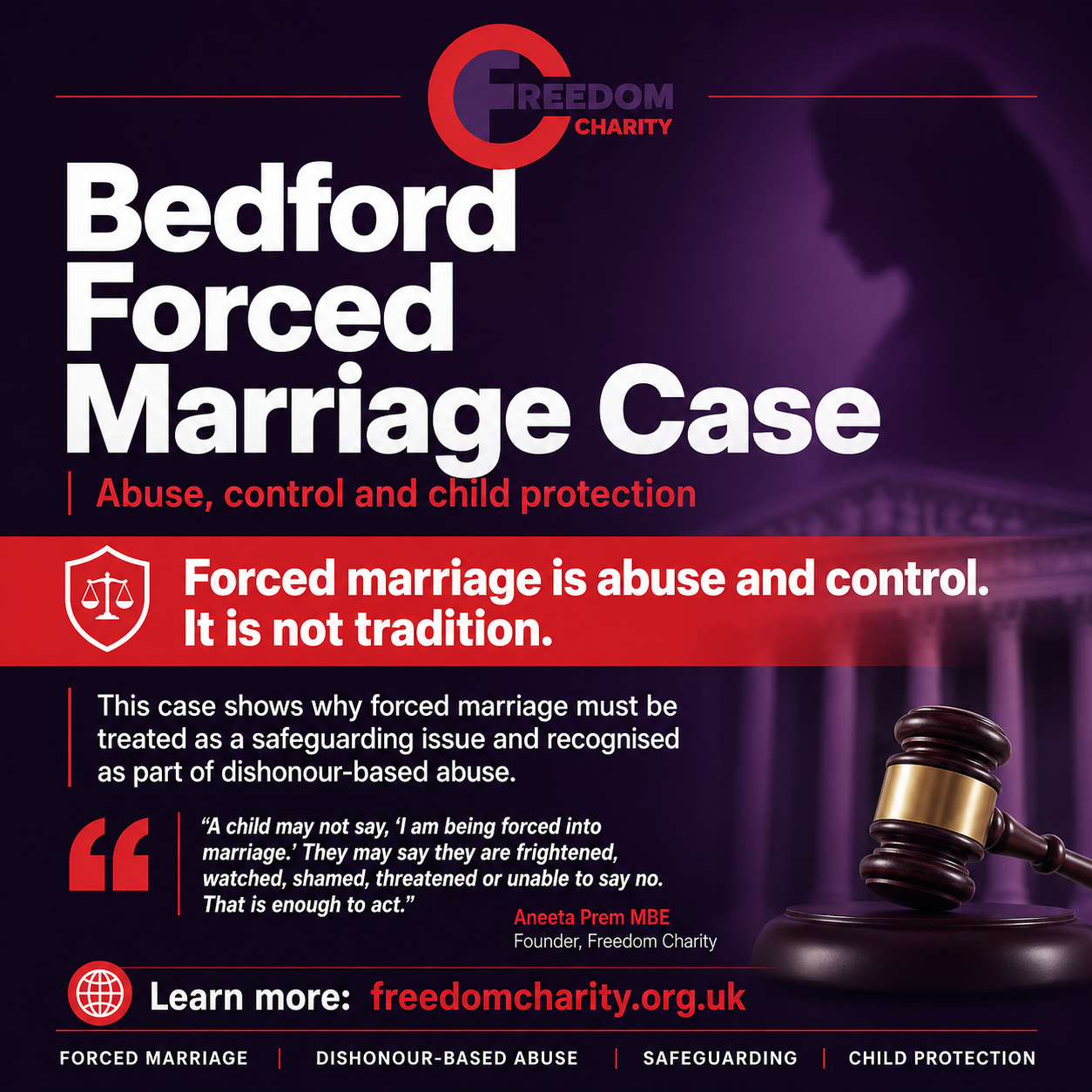
 Bedford Forced Marriage Case Shows Abuse and Control
Why forced marriage demands a safeguarding response
The Bedford forced marriage case involving Mohammed Al-Amin shows why no one should excuse forced marriage as tradition, culture or family expectation.
At Luton Crown Court, Al-Amin, 24, of Saxon Way in Great Denham, received a prison sentence of three years and seven months. Reports say he forced a teenage girl into marriage and committed sexual offences against her. He faced one count of forced marriage and two counts of sexual activity with a child. The court also gave him a five-year restraining order, and he will remain on the Sex Offenders Register for seven years.
According to reports based on Bedfordshire Police information, Al-Amin coerced the victim into an Islamic marriage over Zoom while she was under 18. The ceremony took place in a language she did not understand. Police information also described controlling behaviour, including pressure over how she dressed and behaved to avoid bringing “shame” on him and his family.
This case carries a clear warning. A ceremony does not create consent. Silence does not prove agreement. Fear is not choice.
Aneeta Prem MBE: “A child does not need legal language to be at risk”
Aneeta Prem MBE, Founder of Freedom Charity, said:
“The Bedford forced marriage case shows why adults must stop waiting for children to describe abuse in perfect legal language. A child may not say, ‘I am being forced into marriage.’ They may say they feel frightened, watched, shamed, threatened or unable to say no. That should be enough for adults to act. Forced marriage is not faith, culture or family protection. It is coercion. When a child faces this risk, safeguarding must come first.”
What the Bedford forced marriage case reveals
This case did not only involve a marriage ceremony.
The reported facts show a wider pattern. A child faced pressure. A ceremony took place over Zoom. A language barrier reduced her understanding. Shame became a tool of control. Sexual abuse formed part of the offending. After the relationship ended, threats and abusive messages continued.
That pattern matters.
Forced marriage can sit beside sexual abuse, domestic abuse, emotional pressure, family control, harassment, isolation and online intimidation. It can also form part of dishonour-based abuse.
Many children cannot explain the full danger at once. Some withdraw from school or friends. Others become anxious about family reaction. A child may seem controlled by an older person, talk about shame, or say they cannot refuse.
Professionals must take those signs seriously.
Forced marriage is not consent
Forced marriage breaks UK law. GOV.UK defines forced marriage as a situation where one or both people do not or cannot consent, and someone uses pressure or abuse. GOV.UK also describes forced marriage as domestic abuse and a serious abuse of human rights.
Pressure can include physical abuse, sexual violence, emotional abuse, psychological pressure, financial abuse and shame. In many cases, the person at risk feels trapped before any ceremony happens.
For that reason, the key question is not whether a ceremony took place. The key question is whether the person had freedom, safety, understanding and genuine choice.
The law protects children from marriage before 18
The law now gives children stronger protection.
Since 27 February 2023, 16- and 17-year-olds cannot marry or enter a civil partnership in England and Wales, even with parental consent. GOV.UK says the change made it illegal to arrange for children to marry under any circumstances, whether or not anyone uses force.
This matters because children may appear to comply when fear, grooming, dependence or control shapes their choices. A child may say yes because saying no feels impossible.
Compliance under pressure is not consent.
Forced marriage is not faith
Reports described the ceremony in this case as an Islamic marriage over Zoom. That detail needs care.
Freedom Charity challenges forced marriage without demonising any faith or community. Religion does not cause the abuse. Coercion causes the abuse.
Detective Constable Hollie Fraser, who investigated the case, said forcing someone into marriage without consent is “abuse and control, not tradition.”
Every school, police station, safeguarding team and community setting should hear that sentence.
Forced marriage remains hidden
In 2024, the Forced Marriage Unit received 812 contacts relating to possible forced marriage and/or possible female genital mutilation. Those contacts included 229 forced marriage advice and support cases, 11 FGM advice and support cases, and 572 forced marriage enquiries.
The same official data recorded 83 cases involving victims aged 17 or under. It also showed that British nationals, including dual nationals, made up 74% of victims in advice and support cases.
These figures do not show the full scale of abuse. Fear, family pressure, shame and silence often hide forced marriage.
That is why prevention must start early.
Why schools and professionals must act earlier
Freedom Charity provides safeguarding resources on forced marriage, female genital mutilation and dishonour-based abuse. Its PSHE educational resources help schools teach these issues safely and clearly.
Freedom Charity’s book But It’s Not Fair helps children and professionals understand forced marriage and dishonour-based abuse in an age-appropriate way.
Education gives children language before a crisis. It helps them understand that marriage must involve choice. It also teaches them that pressure, threats and shame are warning signs.
Professionals need confidence too. In forced marriage cases, the wrong response can increase danger. No one should confront the family or alleged perpetrator without specialist safeguarding advice.
Freedom Charity’s position
The Bedford forced marriage case should not be dismissed as rare, distant or exceptional.
Forced marriage happens in the UK. It can involve children. It can happen online. Sexual abuse, threats and coercive control may also appear in the same pattern. Risk can continue after a relationship ends.
Freedom Charity believes prevention must start before crisis. The law matters, but law alone cannot protect a child who does not know that adults will listen.
Children need education. Schools need resources. Professionals need training. Communities need clear language.
Forced marriage is abuse and control. No one should soften it into culture, faith or family expectation.
If someone faces immediate danger, call 999.
If you worry about forced marriage, FGM or dishonour-based abuse, seek specialist safeguarding advice. Do not confront the family or alleged perpetrator yourself.
You can contact Freedom Charity for information about our work, resources and safeguarding education. You can also donate to Freedom Charity to support prevention work with children, schools and communities.
FAQ
What is the Bedford forced marriage case?
The Bedford forced marriage case concerns Mohammed Al-Amin. Reports say he received a prison sentence at Luton Crown Court after forcing a teenage girl into marriage and committing sexual offences against her.
Is forced marriage illegal in the UK?
Yes. UK law makes forced marriage illegal. GOV.UK describes forced marriage as domestic abuse and a serious abuse of human rights.
Can 16- and 17-year-olds marry in England and Wales?
No. Since 27 February 2023, 16- and 17-year-olds cannot marry or enter a civil partnership in England and Wales, even with parental consent.
Is forced marriage the same as arranged marriage?
No. In an arranged marriage, both people have a choice. In a forced marriage, one or both people do not or cannot consent, and someone uses pressure or abuse.
Why is forced marriage a safeguarding issue?
Forced marriage can involve coercion, fear, threats, sexual abuse, emotional pressure, isolation, shame and family control. When a child faces this risk, professionals must treat it as a child protection concern.
What should someone do if they face forced marriage?
If someone faces immediate danger, call 999. For concerns about forced marriage, FGM or dishonour-based abuse, seek specialist safeguarding advice. Do not confront the family or alleged perpetrator, as this may increase risk.
Source list
Sources used: Bedford Independent; Greatest Hits Radio Beds, Bucks & Herts; GOV.UK forced marriage guidance; GOV.UK Forced Marriage Unit statistics 2024; Freedom Charity forced marriage page; Freedom Charity FGM page; Freedom Charity PSHE educational resources; Freedom Charity But It’s Not Fair page; Freedom Charity contact and donation pages.
By Aneeta Prem MBE, Founder of Freedom Charity
Published: 26 April 2026