



 Child Marriage Law UK: Why Every Child Must Be Protected Until 18
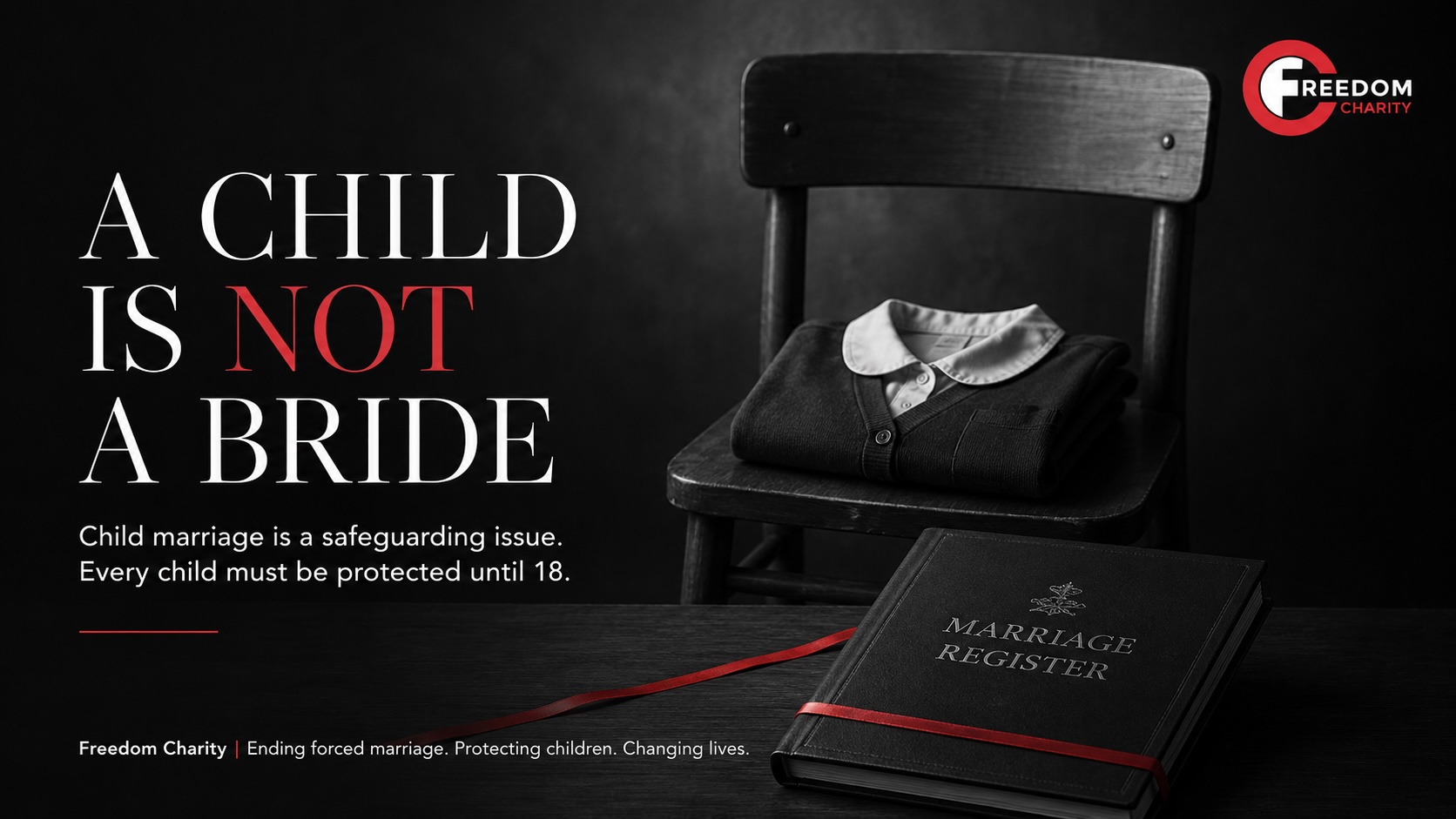
A child can be dressed for a wedding and still be a child. No ceremony, family blessing, community custom or legal loophole should disguise that fact.
The child marriage law UK debate is not only about age. It asks whether the law sees a child as a child, even when adults call the arrangement marriage. Freedom Charity wants one clear standard: no child should marry before 18.
Child marriage is a safeguarding issue. In many cases, it is child abuse. Where pressure, fear, poverty, dishonour, family expectation or control shapes the decision, a child does not freely choose marriage. Adults move her out of childhood before she has the power to resist.
Freedom Charity did not arrive at this issue after the law changed. For more than a decade, Freedom has campaigned, advised government, lobbied, educated schools and argued that forced marriage and child marriage belong in safeguarding and child protection, not behind the language of private family choice. Freedom’s public record includes its work on forced marriage law reform, school prevention and its continuing call for Scotland to raise the marriage age to 18.
Afghanistan now shows the most brutal version of the danger. Recent Guardian reporting says a new Taliban divorce decree appears to recognise child marriage within Afghanistan’s legal structure and may make it almost impossible for girls and young women to leave a marriage without their husband’s agreement. UNAMA has also expressed grave concern about the decree and its impact on women and girls.
The UK must be careful before it condemns abuse abroad while leaving gaps closer to home. England and Wales now prohibit marriage before 18. Scotland still allows marriage and civil partnership from 16. Northern Ireland has introduced reform to raise the age to 18. That inconsistency should not remain.
What is child marriage?
Child marriage means a marriage or informal union where one or both people are under 18. UNICEF calls marriage before 18 a fundamental violation of human rights and links the practice to poverty, family honour, social norms, weak legal frameworks and laws that fail to protect children.
The harm does not begin and end with the wedding day. Child marriage can cut short education, isolate a child from friends and trusted adults, increase exposure to abuse, create pressure around pregnancy and remove the ordinary protections of childhood.
New WHO evidence on violence against adolescent girls
A technical brief published by the World Health Organization (WHO) and UNFPA on 5 October 2026 estimates that, in 2023, about 43 million girls aged 15–19 worldwide had experienced intimate-partner violence, non-partner sexual violence, or both. It also reports that countries with higher rates of child marriage tend to have higher levels of intimate-partner violence against adolescent girls. This is an association; it does not prove that child marriage caused each incident of violence.
These are global estimates of violence against adolescent girls, not UK forced-marriage figures or a count of child brides. The findings reinforce the need to keep girls in education, prevent child marriage and provide safe, survivor-centred support. Read the WHO–UNFPA technical brief (5 October 2026).
UNICEF also warns that child brides often become pregnant during adolescence, face greater risks around pregnancy and childbirth, and may experience serious mental health harm through isolation.
Girls face the greatest risk. Boys can also suffer harm. The principle remains the same: no child should carry adult legal, sexual, domestic or family expectations before they are old enough to stand safely in their own life.
Childhood should not end at a wedding ceremony.
What is the child marriage law UK position?
The child marriage law UK position remains inconsistent.
England and Wales changed the law on 27 February 2023, when the Marriage and Civil Partnership (Minimum Age) Act 2022 came into force. Since then, 16 and 17-year-olds can no longer marry or enter a civil partnership in England and Wales, even with parental consent.
The reform also strengthened criminal law. It now makes it a criminal offence to exploit vulnerable children by arranging for them to marry, whether or not force is used.
This matters because parental consent never gave enough protection. In some families, the adult whose consent the system relies on may also form part of the pressure.
Scotland remains different. The Scottish Government’s own consultation confirms that a person can marry or register a civil partnership in Scotland once they are 16 or over. The same consultation asks whether Scotland should raise the minimum age from 16 to 18.
Northern Ireland has also begun reform. In March 2026, the Northern Ireland Finance Minister introduced the Marriage and Civil Partnership Bill. The Bill would raise the minimum age for marriage and civil partnership from 16 to 18. Current law in Northern Ireland still allows 16 and 17-year-olds to marry or form a civil partnership with parental or equivalent consent.
A child should not receive stronger or weaker protection because of geography.
Freedom Charity’s long campaign to protect children
Freedom Charity has said this for years: forced marriage is not a private family matter. It is abuse. When a child is involved, professionals must treat it as a child protection issue.
For more than a decade, Freedom has campaigned, advised government, lobbied for stronger law, worked with schools and argued that children need the protection of legislation, not the illusion of parental consent. That work helped move forced marriage out of silence and into the language of law, safeguarding and child protection.
Freedom’s work has always been practical as well as legal. The charity has supported children and young people, challenged silence around forced marriage, created school resources, developed prevention tools and worked to ensure professionals understand the risk before a child disappears from education, travel or contact.
Freedom’s forced marriage book, But It’s Not Fair, was written by Aneeta Prem to help young people recognise coercion and control, understand consent and seek help safely. PSHE Quality Mark lesson plans support its use with schools, professionals and families.
The charity’s Not in My Name campaign also speaks directly to boys and young men about FGM, forced marriage and dishonour abuse. Prevention cannot only speak to girls. Boys and young men must help change the peer norms and family expectations that allow abuse to continue.
Freedom did not campaign for a change in wording. It campaigned for a change in protection.
Why Scotland must raise the marriage age to 18
Scotland is now the clearest legal gap in UK child marriage protection.
The Scottish Government consultation recognises that 16 and 17-year-olds may need protection in serious legal decisions. Yet the consultation also accepts that this protection does not apply in the same way to marriage or civil partnership. A 16 or 17-year-old proposing to marry in Scotland follows the same process as an adult.
That is the weakness.
Marriage is not a small transaction. It can affect education, housing, money, sex, pregnancy, immigration, family control, safety, social isolation and access to help. If the law protects young people in other serious decisions, it should not abandon them at the point of marriage.
Freedom Charity has already called for Scotland to raise the minimum age of marriage and civil partnership to 18. Freedom has also argued that reform must recognise child marriage as a safeguarding issue and trigger child protection duties whenever a proposed marriage involves someone under 18.
The legal age matters because it gives professionals a clear line. It tells registrars, teachers, social workers, police officers, health professionals, families and communities that marriage belongs in adulthood, not childhood.
Scotland should not remain the place where a 16-year-old can still enter marriage without an automatic safeguarding threshold.
Why this week’s public debate matters
This week’s public discussion around a reported 16-year-old marriage in a high-profile family has made many people ask why any legal system still allows marriage before 18. ITV reported that Tyson Fury spoke about his 16-year-old daughter’s wedding, which took place on the Isle of Man.
This should not become an attack on a child, a family or a community. That would be wrong.
The proper question is legal and safeguarding-based: why should any system still permit a 16-year-old to marry?
The Isle of Man is a Crown Dependency, not part of the United Kingdom. Crown Dependencies have their own legislative assemblies and legal systems. That distinction matters because English and Welsh law does not apply there in the same way.
Even so, the public reaction matters. It shows that many people now understand something simple. A 16-year-old may appear confident. She may speak clearly. She may say she wants the marriage.
Yet safeguarding is not only about the words spoken in public. It is about whether a child could safely say no in private.
A child may be old enough to repeat the words expected of her. That does not prove she is free.
Why forced marriage involving children is child abuse
Forced marriage occurs when one or both people do not, or cannot, consent to the marriage and pressure or abuse takes place. UK Government guidance says forced marriage is illegal, a form of domestic abuse and a serious abuse of human rights. It also explains that people at risk can seek a Forced Marriage Protection Order.
In England and Wales, the law now goes further when a child is involved. It makes it illegal to arrange for a child to marry before 18, whether or not force is used.
That distinction is crucial.
An arranged marriage is not the same as a forced marriage. In an arranged marriage, both people freely consent. In a forced marriage, consent is absent, unsafe or compromised.
When the person involved is a child, professionals must treat the risk differently. A child may not have money, housing, independence, safe adults, legal knowledge or confidence. She may fear violence, abandonment, disgrace, exclusion or accusations that she has brought dishonour on the family.
Freedom Charity uses the term dishonour abuse because there is no honour in abuse. Children should not carry the weight of adult reputation.
What the 2025 forced marriage figures show
The latest Forced Marriage Unit figures show why this issue remains urgent.
In 2025, the joint Home Office and Foreign, Commonwealth and Development Office Forced Marriage Unit received 1,295 contacts relating to possible forced marriage and/or possible FGM. These included 406 cases where the FMU provided tailored assistance and 889 enquiries.
The age data is stark. In 2025, 40% of tailored assistance cases involved victims aged 17 and under. That means 163 cases involved children. Of those, 87 involved children aged 15 and under, and 76 involved young people aged 16 or 17.
Those figures matter because 16 and 17-year-olds remain visible in forced marriage cases. They are exactly the age group most likely to be wrongly treated as old enough to cope with adult pressure.
The FMU data also shows that forced marriage is not only an overseas issue. Some 2025 tailored assistance cases had no overseas element and related entirely to the UK.
That destroys the lazy assumption that forced marriage always happens somewhere else. It can involve travel abroad, relatives overseas or immigration control. It can also be planned, pressured and carried out here.
Why Afghanistan shows what happens when girls lose rights
Afghanistan shows what happens when girls lose school, legal protection and freedom, then adults tell them marriage is their future.
The Guardian reported on 22 May 2026 that child marriage appears to have gained legal recognition for the first time under the Taliban in Afghanistan. The report says activists believe early and forced marriage has risen sharply since the Taliban barred girls from education after the age of 11.
UNAMA has expressed grave concern about Taliban Decree No. 18, also described as the Code on Judicial Separation of Spouses. Although the full public English text does not appear to be available, UNAMA has warned that the decree further entrenches systemic discrimination against women and girls and undermines their autonomy, equality and access to justice.
Why Decree No. 18 matters
The most dangerous concern is the treatment of silence. UNAMA has warned that the silence of a girl who has reached puberty may be interpreted as consent to marriage.
In safeguarding terms, that is profoundly unsafe. A child may stay silent because she is frightened, dependent, threatened, isolated, ashamed or unable to challenge her parents, male relatives, husband or community. Silence is not consent.
Decree No. 18 also appears to recognise married girls within the legal framework. UNAMA has said this implies that child marriage is permitted.
That matters because law does not only punish behaviour. It also tells families, courts and communities what a state is prepared to tolerate.
This is about power
This is not simply a divorce law. It is about power.
Where fathers, grandfathers, husbands, male guardians or state-controlled courts hold more authority than the girl herself, the child becomes the least powerful person in the decision about her own life. Adults can negotiate her future around her. Her education can end. Marriage can affect her body, safety and childhood. Leaving can become harder.
UNICEF has also warned that Afghan girls face an increasing risk of child marriage. It estimated that 28% of Afghan women aged 15 to 49 married before 18 and has reported serious concerns about child marriage and the sale of children in parts of Afghanistan.
This is the human cost of legal language.
A girl who cannot go to school is easier to control.
Without the power to refuse marriage, she lacks protection.
When the law makes leaving harder, marriage can become a trap.
Afghanistan is not Scotland. It is not England. It is not the Isle of Man. However, the lesson is clear. When girls lose education and legal protection, marriage can become a mechanism of control.
A daughter is not property. Parents do not own their daughters. Governments do not own girls. No child’s silence should ever be used to justify marriage.
Girls’ rights do not end at puberty. They do not end at marriage. They do not belong to fathers, husbands, relatives or governments.
What about first-cousin marriage?
The debate about first-cousin marriage needs care. It must not become a proxy for prejudice, racism or attacks on particular communities.
A Private Member’s Bill, the Marriage (Prohibited Degrees of Relationship) Bill, seeks to prohibit the marriage of first cousins. It is not currently law.
Freedom Charity should not conflate cousin marriage with forced marriage. They are not the same issue.
The safeguarding test is sharper and stronger. It is not ethnicity, religion or family structure. The test is age, consent, pressure, coercion, fear, power and freedom.
Where a marriage involves a child, the law must protect the child. Where any marriage involves threats, control, isolation, dishonour, immigration abuse, financial control or fear, professionals must treat it as a safeguarding concern.
Why law reform must be matched by education
Law matters. It sets the line. It gives professionals confidence. It tells families that childhood cannot be negotiated away.
But the law alone will not protect every child.
A frightened child may not know the law. A teacher may miss the signs. A registrar may focus only on paperwork. A social worker may treat a planned marriage as a family disagreement. A friend may suspect something but not know what to do.
That is why prevention matters.
Freedom Charity supports children and young people through education, safeguarding resources, public awareness and routes to help. The charity’s books, lesson resources awarded the PSHE Association Quality Mark and campaigns help children recognise pressure before crisis point.
Prevention must begin before the ceremony.
It must begin before the airport.
It must begin before the summer holiday.
It must begin before the child disappears from school.
The law can punish abuse after it happens. Education can help stop it before it begins.
Freedom Charity’s call for change
Freedom Charity is calling for one clear child protection standard.
No child should be able to marry before 18.
Scotland should raise the minimum age of marriage and civil partnership from 16 to 18.
Northern Ireland should complete reform so that 16 and 17-year-olds can no longer marry or enter a civil partnership with parental or equivalent consent.
Any attempt to arrange, pressure, persuade or facilitate a marriage involving a child should trigger safeguarding action.
Schools, registrars, police, health professionals and social workers should receive clear guidance on child marriage, forced marriage and dishonour abuse.
Children should learn that forced marriage is abuse, help exists, and family pressure does not remove their rights.
Freedom Charity is available to support schools, safeguarding professionals, policymakers and journalists seeking clear, legally accurate insight on forced marriage, child marriage, dishonour abuse and prevention.
A legacy of protection
Freedom Charity’s work has always been about more than responding after harm has happened. It is about prevention, law change, education and courage.
Child marriage belongs in history. Forced marriage belongs in the safeguarding and criminal justice system, not behind closed doors and polite excuses.
The UK has made progress. England and Wales closed a dangerous loophole. Northern Ireland has begun reform. Scotland now has the opportunity to act.
The law should not wait for another child to disappear into a marriage she could not safely refuse.
Every child should hear the same message.
Your childhood is not negotiable.
Your silence is not consent.
Your future cannot be traded.
Freedom Charity will continue to campaign until every child, in every part of the UK, receives protection until 18.
Need help or worried about someone?
If someone is in immediate danger, call 999.
If you are worried about forced marriage, dishonour abuse or a child at risk, contact Freedom Charity for information and support routes.
FAQs
What is child marriage?
Child marriage means a marriage or informal union where one or both people are under 18. UNICEF calls marriage before 18 a fundamental violation of human rights.
What is the child marriage law UK position?
The UK’s position on child marriage remains inconsistent. England and Wales prohibit marriage and civil partnership before 18. Scotland still permits marriage and civil partnership from 16. Northern Ireland has introduced reform to raise the age to 18.
Is child marriage legal in England and Wales?
No. Since 27 February 2023, 16 and 17-year-olds can no longer marry or enter a civil partnership in England and Wales, even with parental consent.
Is child marriage legal in Scotland?
Scotland currently allows marriage and civil partnership from 16. The Scottish Government has consulted on whether to raise the minimum age to 18.
Is forced marriage child abuse?
Where a forced marriage involves a child, professionals should treat it as a child protection issue. UK Government guidance describes forced marriage as illegal, a form of domestic abuse and a serious abuse of human rights.
Why does Freedom Charity want reform?
Freedom Charity wants every child protected until 18. The law should not leave space for family pressure, fear, poverty, dishonour or coercion to pass as consent.
Sources and further reading
- UK Government: legal age of marriage in England and Wales rises to 18
https://www.gov.uk/government/news/legal-age-of-marriage-in-england-and-wales-rises-to-18 - Marriage and Civil Partnership (Minimum Age) Act 2022
https://www.legislation.gov.uk/ukpga/2022/28/contents - Forced Marriage Unit statistics 2025
https://www.gov.uk/government/statistics/forced-marriage-unit-statistics-2025/forced-marriage-unit-statistics-2025 - Scottish Government consultation on raising the minimum age of marriage and civil partnership
https://www.gov.scot/publications/scottish-government-consultation-family-law/pages/3/ - Northern Ireland Department of Finance: Marriage and Civil Partnership Bill
https://www.finance-ni.gov.uk/news/raising-marriage-age-better-protects-our-children-and-young-people-odowd - UNICEF child marriage data and definition
https://data.unicef.org/topic/child-protection/child-marriage/ - UNICEF child marriage impact information
https://www.unicef.org/protection/child-marriage - Guardian reporting on the Taliban decree and child marriage in Afghanistan
https://www.theguardian.com/global-development/2026/may/22/taliban-legitimising-child-forced-early-marriage-law-women-rights - UNAMA statement on Decree No. 18
https://unama.unmissions.org/en/news/unama-statement-on-afghanistans-de-facto-authorities-decree-no-18-code-on-judicial - Freedom Charity: forced marriage law change
https://freedomcharity.org.uk/aneeta-prem-the-forced-marriage-law-change/ - Freedom Charity: Scotland child marriage law
https://freedomcharity.org.uk/scotland-child-marriage-law/ - Freedom Charity: But It’s Not Fair
https://freedomcharity.org.uk/but-its-not-fair-forced-marriage-book/ - Freedom Charity: Not in My Name campaign
https://freedomcharity.org.uk/not-in-my-name-campaign/
Aneeta Prem MBE is the founder of Freedom Charity, a UK safeguarding charity working to protect children and young people from forced marriage, FGM, dishonour abuse and related harm. She is the author of But It’s Not Fair and Cut Flowers, which support education and prevention work with children, schools and professionals.
Aneeta Prem,London,22 May 2026