



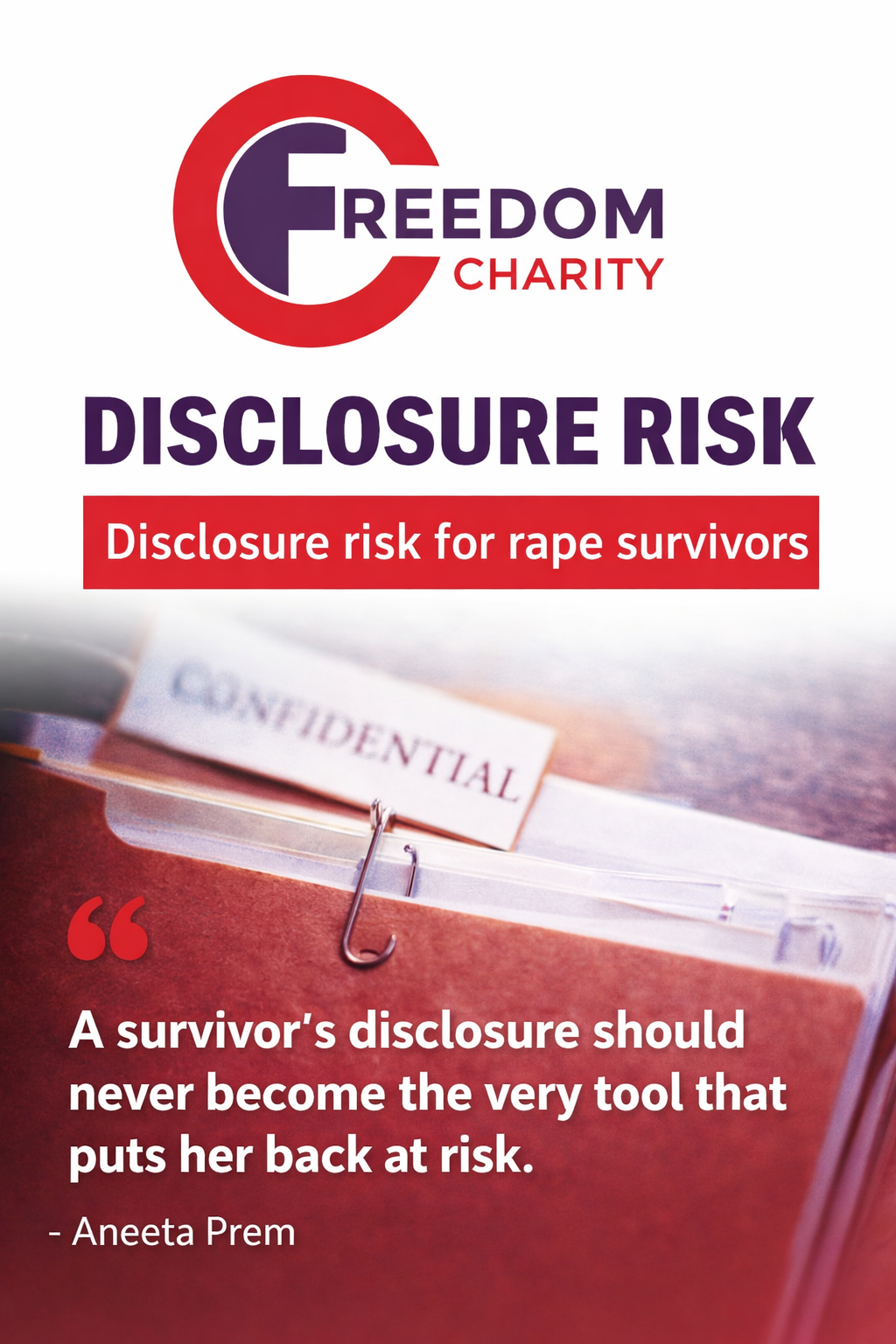
Disclosure Risk
New rules in England and Wales were meant to curb intrusive requests for counselling notes. The law has tightened. The fear has not gone away. For survivors of rape, forced marriage and abuse, disclosure can still carry its own risk.
By Aneeta Prem
London | 7 April 2026
A woman reports rape, seeks counselling and starts trying to recover.
Then the legal process begins, and someone asks for the notes.
Too many survivors discover that reality too late. Services urge them to speak, disclose and seek help. Far fewer explain clearly what may happen if criminal or family proceedings later draw in records of that disclosure. That gap matters. It shapes trust, safety and, in some cases, whether a victim speaks at all.
The law has changed
England and Wales introduced an important reform on 12 January 2026. The Victim Information Requests Code now says police and other authorised persons should start from the position that they should not ask for counselling information unless the legal test is met. They must justify any request properly. The reform followed years of concern that investigators were seeking deeply personal material from victims, especially in rape cases, too readily.
That change matters. It does not create absolute protection.
Confidentiality still has limits
Confidentiality sits at the heart of counselling. It helps people speak honestly. Without it, many survivors would never disclose the truth of what happened to them. Yet confidentiality does not give records complete immunity from legal scrutiny. In some circumstances, legal processes may still pull therapy or support records into dispute.
That is why this issue goes far beyond paperwork. It sits at the point where trauma, privacy and evidence collide.
As I have seen repeatedly in frontline work, survivors are told to disclose, but they are far less often told what may happen to the record of that disclosure once proceedings begin. That is where trust can break down.
Why rape cases raise the stakes
Counselling notes rarely contain routine detail. They may hold an account of rape, fear, shame, self-blame, suicidal thoughts, coercive control or the day-to-day impact of trauma. For some survivors, those notes contain the most intimate record they have ever given.
When a legal process seeks that material, the effect can be profound. Even when a lawyer narrows or challenges a request, the possibility alone can deter disclosure. Survivors may hold back in therapy, avoid support altogether or step away from a case because they fear exposure. Lawyers may describe that as disclosure and relevance. Survivors experience it as a risk.
“Survivors are told to speak, but they are far less often told what may happen to the record of that disclosure once legal proceedings begin. That gap is where trust breaks down.” Aneeta Prem
Forced marriage makes the issue sharper
The risk becomes even more urgent in cases involving forced marriage and wider abuse. In those cases, records may contain disclosures of rape within marriage, threats, family pressure, surveillance, immigration abuse, reproductive coercion or years of silence enforced by fear and shame.
We must speak plainly. Forced marriage is not a private family matter. In too many cases, it becomes a structure of coercion and abuse. UK statutory guidance has long recognised that women forced into marriage may face repeated rape, sometimes until pregnancy, as well as ongoing domestic abuse within the marriage.
“Forced marriage is not a ceremony. In too many cases, it becomes a system of coercion that can include repeated sexual violence within marriage, alongside control, threats and isolation. We have to name that reality clearly if we are serious about protection.”
When a survivor finally speaks, the record of that courage should not feel like the next danger.
What victims need to know
Do not assume that counselling or support records are automatically untouchable. Ask how a service records, stores and shares information. If someone seeks your records, ask who is asking, what dates the request covers, why they say they need the material and whether they have limited the request to what is strictly necessary.
Most importantly, do not treat a request as routine just because someone has made it. In criminal matters, the current Code says authorities should request counselling information only when necessity and proportionality support that step. They should not act on speculation alone. Victims should receive written notice, and the process should seek their views where reasonably practicable.
What lawyers need to remember
Do not treat therapy notes as a standard evidential resource. Keep the legal route clear. A criminal justice request under the current Code is not the same as a disclosure dispute in family proceedings. Ask whether the request is genuinely necessary, whether less intrusive steps have already been taken and whether the scope can really be justified.
Precision matters. So does the human cost.
“A survivor’s disclosure should never become the very tool that puts her back at risk. If seeking help creates fear of exposure, the system is not protecting victims. It is deterring them.”
What social workers should avoid
Do not promise absolute confidentiality unless the law allows you to do so. That kind of reassurance can create deeper harm later. Explain the position accurately instead. Records are private and protected, but legal processes can still request or order them in some circumstances.
That honesty does not discourage disclosure. It supports safeguarding.
The real test
The justice system must balance privacy and fair trial rights. No serious person disputes that. But if victims start to believe that seeking help may later expose the record of their recovery, the system has not solved the problem. It has only narrowed it.
The law has moved. Practice must now catch up.
Seeking help should not create a new risk.
Sources
Victim Information Requests Code of Practice, January 2026.
BACP guidance on confidentiality.
UK forced marriage guidance.
Victim information requests Code of Practice
BACP confidentiality guidance