



Dishonour Abuse Hansard: “There is no honour in abuse” in the House of Lords
Use this Meta description


Dishonour Abuse Hansard: “There is no honour in abuse” in the House of Lords
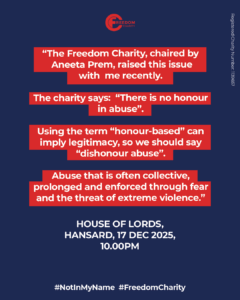
Dishonour Abuse belongs in the official record, because words shape protection. On 17 December 2025, in the House of Lords, Baroness Jones of Moulsecoomb made the point plainly: “This has nothing to do with honour. This is dishonour, and that is what we should call it.” This is now part of the Dishonour Abuse Hansard record.
Dishonour Abuse Hansard: what Baroness Jones said
During her speech, Baroness Jones referenced Freedom Charity directly and put our words into Hansard: “There is no honour in abuse”.
She also warned that language can legitimise harm: “Using the term ‘honour-based’ can imply legitimacy, so we should say ‘dishonour abuse’”.
In other words, this is not semantics. Instead, it is safeguarding.
Why Freedom Charity uses the term Dishonour Abuse
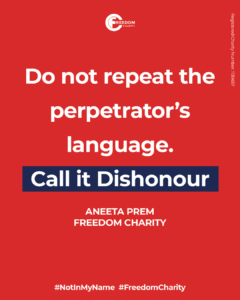
Language is never neutral in these cases. It either protects, or it excuses.
When institutions repeat the perpetrator’s framing, even unintentionally, three things can follow.
First, the abuse can start to sound conditional, as if violence might be “understandable” in context.
Secondly, risk can be missed because the words soften what is happening in front of a professional.
Thirdly, survivors can hear the system echo the language used to silence, threaten, and control them.
Dishonour Abuse does the opposite. It removes the false gloss. More importantly, it places accountability where it belongs, with perpetrators. That is why Freedom Charity uses this term, and that is why we will keep using it.
Dishonour Abuse Hansard: why the framing must change
Freedom Charity’s position is direct.
Honour is not a motive that deserves deference. Rather, it is a narrative used to control.
So we do not treat this as cultural nuance. Instead, we treat it as a safeguarding red flag.
We do not treat it as a family disagreement. We treat it as coercion, intimidation, and escalating risk.
We do not treat it as private. We treat it as public harm.
For that reason, Baroness Jones’ intervention matters. It is rare to hear moral clarity stated so cleanly, and then recorded in the Dishonour Abuse Hansard entry.
What we want professionals to do differently
Dishonour Abuse Hansard should translate into practice, not just commentary. That starts with the first professional who hears a disclosure.
Act early
When someone discloses fear, control, threats, surveillance, restrictions, or being taken abroad, treat it as urgent. Delay creates space for escalation.
Do not mediate
Family reconciliation is not a safeguarding plan. Likewise, contacting relatives for “context” can increase risk. Safety comes first.
Recognise the pattern
These cases can involve multiple perpetrators and wider collusion. Therefore, risk may sit in the group, not only in one individual.
Use survivor-centred language
Choose words that name abuse clearly. Avoid phrases that imply legitimacy or “mutual conflict”.
Record what you see
If services cannot name it, they cannot track it. If they cannot track it, they cannot connect the dots across agencies. In practice, pattern is often the danger.
Why this moment matters for survivors
For many survivors, disclosure is the hardest step. Fear of disbelief is real, and fear of retaliation is real. In addition, fear of being located, removed, or punished can be overwhelming.
That is why the Dishonour Abuse Hansard record matters. It gives survivors language that does not load blame onto them. It also signals to perpetrators that society does not accept their justification.
What Freedom Charity is doing next
We will use the Dishonour Abuse Hansard record in three ways.
First, we will drive public understanding through plain language and shareable content.
Next, we will reinforce professional safeguarding practice with language that protects survivors.
Finally, we will keep pressing for consistent recognition across agencies, so no one’s safety depends on luck, postcode, or whether one professional happens to have specialist knowledge.
That is also why we are publishing social media tiles and short clips now. The message needs to travel further than Parliament.
Dishonour Abuse Hansard: read the official record
You can read the House of Lords Hansard record here:
https://hansard.parliament.uk/Lords/2025-12-17/debates/3486BCAD-D920-4CEE-A79A-75D5B4CD3EC5/CrimeAndPolicingBill
Call to action
If you support this shift in language, share our posts and use the words Dishonour Abuse. When you see “honour” framing, challenge it calmly and clearly. Above all, if you work in safeguarding, remember that language can open a door to safety, or it can quietly close it.