



Dowry abuse explained: why it happens and how it harms girls
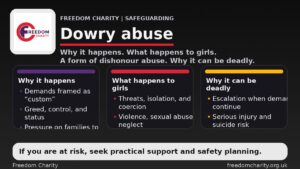
Dowry abuse is domestic abuse linked to dowry demands for money, jewellery, housing or other assets connected to marriage. People sometimes describe it as “custom”. In practice, perpetrators use it to extract resources, enforce obedience and punish refusal. As a result, the risk can escalate quickly.
This page explains why dowry demands arise, what happens to girls and women, and what good safeguarding looks like when families use coercion, threats or violence to enforce payment.
What is dowry abuse?
Dowry abuse involves harm or control linked to demands made before, during or after marriage. These demands may be explicit or implied. They can also change over time.
In UK law, dowry is not a standalone offence. However, perpetrators can commit crimes when they enforce demands through:
-
coercive and controlling behaviour
-
threats and harassment
-
assault
-
sexual violence
-
unlawful detention or false imprisonment
Warning signs include escalating demands, isolation, control of money, threats, and punishment after refusal.
Why does dowry abuse happen?
Dowry abuse persists because it serves clear aims for perpetrators and those who collude with them.
Extraction
First, perpetrators use dowry demands to transfer wealth. Families may sell assets, borrow money, or give up housing security to keep a daughter “safe”.
Control
Second, perpetrators use demands to build coercive control. Compliance becomes the test. Refusal becomes “disrespect”. Then punishment follows.
Status and entitlement
Third, demands can rise through entitlement and social competition. This is not a harmless tradition. It is a hierarchy enforced through fear and domination.
How dowry abuse typically unfolds
In many cases, the pattern looks like this:
-
A demand is introduced, sometimes as a “request”.
-
The victim is told that refusal will shame the family.
-
Pressure increases. The victim faces blame, monitoring or isolation.
-
Punishment follows, ranging from humiliation to violence.
-
The victim is pushed to secure payment from her own family, even if it will cause poverty or debt.
Therefore, perpetrators often use the victim as the messenger. That dynamic traps her between two families.
What happens to girls and women
When families enforce dowry demands, the consequences usually fall on the girl or woman.
Victims commonly face:
-
Humiliation is designed to break confidence
-
isolation from friends, family, education or work
-
financial control, including seized wages or blocked accounts
-
threats of abandonment, retaliation or further violence
-
physical violence framed as punishment
-
sexual violence used as control
Importantly, more than one perpetrator may take part, including in-laws. That raises risk and makes disclosure harder.
What happens to families
Dowry demands can devastate families as well.
Families can face:
-
forced sales of valuables or property
-
unmanageable debt
-
long-term financial instability
-
intimidation or harassment
In the UK, Freedom Charity hears reports of families being pressured to hand over housing or major assets, leaving parents financially exposed. When families cannot comply, perpetrators may blame them for the abuse. That blame is part of the control.
Why dowry abuse can become deadly
People sometimes describe serious harm as sudden. However, severe injury and death more often follow prolonged coercive control and escalating punishment.
When institutions dismiss early signs as “family issues”, perpetrators gain time. As a result, risk can rise quickly behind closed doors.
The UK does not use “dowry death” as a legal category. Even so, the behaviours that lead to fatal outcomes remain criminal. These include assault, coercive control, threats, unlawful detention and homicide.
Why professionals miss dowry abuse
Professionals sometimes treat dowry demands as a private dispute or a cultural matter. That approach delays safeguarding and weakens risk assessment.
Victims may also fear:
-
immigration repercussions
-
being disbelieved
-
retaliation if they disclose
-
family pressure to stay silent
So, agencies must focus on harm, control and risk. They should not debate “custom”.
Dowry abuse and the “honour” label
Some agencies group this harm under “honour-based abuse”. Freedom Charity uses dishonour abuse as a clearer description. It keeps the focus on criminal harm and accountability.
What good safeguarding looks like
If dowry abuse is suspected, safer practice assumes:
-
Escalation may be underway
-
Multiple perpetrators may be involved
-
Surveillance may be present
-
Disclosure may trigger retaliation
-
Family members may also face threats
Early recognition protects victims. It allows safe planning and timely intervention.
How Freedom Charity can help
Freedom Charity supports people at risk of forced marriage, dishonour-based abuse and related harmful practices. Support is confidential and focused on safety.
If you are worried about dowry abuse, help is available. You do not have to manage it alone.
If you are in immediate danger, call 999. If you cannot speak safely, seek help when you can.