



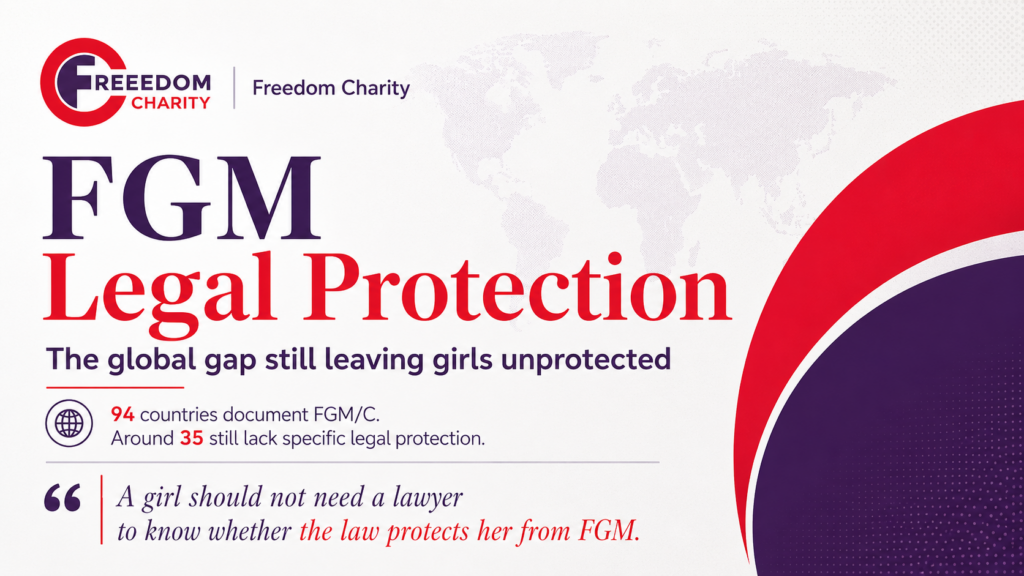
FGM Legal Protection: The Global Gap Still Leaving Girls Unprotected
By Aneeta Prem MBE, Founder of Freedom Charity
A girl should not need a lawyer to know whether the law protects her from FGM.
Evidence now places female genital mutilation/cutting, known as FGM/C, in at least 94 countries. Yet around 35 countries where evidence documents FGM/C still lack specific national laws or legal provisions addressing the practice.
Some states may rely on general criminal law. That does not give girls the same clear, named protection.
This is not a data gap. It is a state-protection gap.
What is FGM/C?
Female genital mutilation/cutting refers to procedures that involve the partial or total removal of external female genitalia, or other injury to female genital organs, for non-medical reasons.
People sometimes use the term FGM/C because researchers, survivors and communities may describe the practice as “cutting”. In law, health, safeguarding and human rights work, the harm must remain clear.
FGM/C is not harmless tradition. It violates bodily autonomy, childhood, dignity and equality.
The World Health Organization states that FGM has no health benefits. The practice can cause severe bleeding, urinary problems, cysts, menstrual difficulties, infections, childbirth complications, increased risk of newborn deaths and psychological harm.
WHO classifies FGM into four major types. These include partial or total removal of the clitoral glans, removal of the labia, infibulation, and other harmful procedures such as pricking, piercing, scraping or cauterising the genital area.
Families and practitioners usually subject girls to FGM/C between infancy and adolescence. Adult women can also face it. Where children are involved, the issue becomes a safeguarding concern as well as a health and human rights issue.
Why FGM legal protection matters now
A recent Guardian report placed Sierra Leone back in the global spotlight after First Lady Fatima Maada Bio said she would not openly condemn FGM until she saw “reliable data” that the practice caused harm.
That position demands a clear response.
Medical evidence, survivor testimony, human rights law and safeguarding practice already show the harm. Governments do not need more proof before they protect girls.
Sierra Leone shows why FGM legal protection matters. The country has one of the highest recorded rates of FGM in the world, yet it still has no specific law criminalising the practice.
The ECOWAS Court of Justice has ordered Sierra Leone to enact and implement legislation criminalising FGM. It also directed the state to prevent the practice and protect women and girls.
That ruling matters beyond one country. Courts and human rights bodies increasingly recognise that a state fails in its duty when it knows girls face foreseeable harm and still leaves the law unclear.
FGM/C is a global issue
UNICEF estimates that more than 230 million girls and women alive today have undergone FGM. The largest number live in African countries, followed by Asia and the Middle East. Smaller practising communities and diaspora communities also exist across the world.
Equality Now, the End FGM European Network and the U.S. End FGM/C Network reported in 2025 that evidence documents FGM/C in at least 94 countries. Their global legal mapping found that only 59 of those 94 countries have specific national laws or legal provisions addressing FGM/C.
Around 35 countries therefore remain in the legal gap. Evidence documents FGM/C there, but the 2025 mapping did not identify specific national FGM legal protection.
That gap matters because a child cannot rely on vague protection.
Why general criminal law is not enough
Some governments may argue that assault, child abuse, grievous bodily harm or violence laws can cover FGM/C.
In some cases, prosecutors may use those offences.
However, general criminal law does not provide the same clarity as a specific FGM/C law.
A named FGM/C law tells families, schools, health workers, police, prosecutors, border officials, social workers and courts that the practice is prohibited. It also supports prevention, professional training, risk assessment, survivor recognition and data collection.
When the law does not name FGM/C, uncertainty grows.
A teacher may not know what to report. A health worker may hesitate. Police may miss the risk. Prosecutors may struggle to frame the offence. Families may assume the state has not fully decided where it stands.
That uncertainty places girls in danger.
Methodology: what this country list means
The country categories below follow the evidence categories used in the 2025 global legal mapping by Equality Now, the End FGM European Network and the U.S. End FGM/C Network.
This article does not claim that FGM/C can never lead to prosecution in the countries listed below.
Instead, it identifies countries where evidence documents FGM/C and where the 2025 mapping did not identify a specific national FGM/C law or legal provision.
The distinction matters. A country may have assault laws, child-protection laws or bodily-harm offences, but still lack a specific legal framework for prevention, professional duties, cross-border risk, survivor support and enforcement data.
National data countries without specific FGM/C legal protection identified
These countries require particular attention because national data shows FGM/C. The 2025 global legal mapping did not identify a specific national FGM/C law or legal provision for them.
Liberia
Mali
Sierra Leone
Somalia
The Maldives
Yemen
Indirect estimate countries without specific FGM/C legal protection identified
Many discussions about these countries relate to affected diaspora communities. The legal issue still matters because girls may face risk within the country or through travel abroad for FGM/C. Clear law helps professionals act before harm occurs.
Bulgaria
Czech Republic
Hungary
Latvia
Netherlands
Slovakia
Slovenia
Small-scale study countries without specific FGM/C legal protection identified
Small-scale studies can reveal hidden practice, community-specific risk or under-reported harm. Governments should not dismiss such evidence. They should investigate, collect better data and give girls clear FGM legal protection.
India
Kuwait
Malaysia
Pakistan
Philippines
Russia
Saudi Arabia
Singapore
Sri Lanka
Thailand
United Arab Emirates
Reported evidence countries without specific FGM/C legal protection identified
This category includes countries where evidence may come from media reporting, UN material, government references, NGOs, survivor accounts or anecdotal reports rather than national prevalence surveys.
That does not make the risk irrelevant. It makes better evidence-gathering urgent.
Governments should not wait for a larger data set before protecting girls from foreseeable harm.
Azerbaijan
Bahrain
Brunei Darussalam
Cambodia
Jordan
Libya
Malawi
Qatar
Syria
Vietnam
Colombia: a transition case to watch
Colombia should not sit in the simple “no specific law” list.
In 2025, Colombia appeared within the global legal gap. In June 2026, Colombia’s Congress passed legislation designed to prohibit and prevent FGM. Equality Now described this as the first specific FGM law in Latin America.
At the time of writing, Colombia should remain a transition case. Campaigners, lawyers and policymakers should monitor assent, implementation, public education, protection routes and enforcement.
Legal progress deserves recognition. Real protection, however, depends on what happens after a bill passes.
What Sierra Leone shows the world
Sierra Leone now presents one of the clearest tests of global seriousness on FGM/C.
The Guardian reports that Sierra Leone has no law criminalising FGM. It also reports that the practice often links to initiation into Bondo and Sande societies, where women known as sowei carry out cutting.
This is not simply a domestic cultural issue. State responsibility sits at the centre of it.
The ECOWAS Court has already ordered Sierra Leone to enact and implement legislation criminalising FGM, prevent the practice, protect women and girls, investigate cases and ensure accountability.
When a state knows girls face risk and still leaves the law unclear, it does not remain neutral. It fails to protect.
State silence can become social permission.
Law alone will not end FGM/C
A law by itself will not end FGM/C.
No serious safeguarding organisation should pretend otherwise.
Social pressure, secrecy, ideas about purity, marriageability, sexuality, family honour, gender control and fear of exclusion all help sustain FGM/C. In some places, initiation ceremonies create further pressure. In others, families may hide the practice within medical settings or private arrangements.
Prevention must include education, community engagement, survivor support, professional training and safe reporting routes.
But law still matters.
Law draws the public line. Culture cannot excuse permanent injury. Tradition cannot override bodily autonomy. Children are not the property of families, communities or customs. The state must not look away.
If law is absent, prevention weakens. Poor enforcement turns legal protection into symbolism. Education also matters, because enforcement alone may push the practice further underground.
Effective protection needs law, education, safeguarding, survivor support and accountability together.
Freedom Charity’s work on FGM prevention
Freedom Charity’s position is clear.
FGM/C violates human rights. It creates a safeguarding risk. It is a form of violence against girls and women. Every country where it occurs, or where girls may be taken to be cut, should provide clear, specific and enforceable legal protection.
Freedom Charity has worked for years to prevent FGM, forced marriage and dishonour abuse through education, safeguarding resources, public awareness and practical intervention.
This is not abstract campaigning. Freedom Charity has put prevention directly into classrooms.
Cut Flowers, written by Aneeta Prem MBE, is an educational novel about FGM and safeguarding. It can be used alongside Freedom Charity’s separate FGM lesson resource, which has received the PSHE Association Quality Mark.
Freedom Charity reports donating more than 100,000 educational books to schools, young people and safeguarding settings. Those books help young people recognise abuse, understand risk, challenge harmful practices and know where to seek help.
Education matters because children need language before they can ask for help. Professionals need confidence before they can intervene. Communities need honesty before harm can end.
What politicians should ask
Politicians should stop treating FGM/C as an issue that receives attention once a year and then returns to campaigners.
The legal gap can be measured. The countries can be identified. Survivors have spoken. Harm has been documented.
Every government should answer five questions.
First, has FGM/C been documented in your country or among communities within your jurisdiction?
Second, do you have a specific national law or legal provision addressing FGM/C?
Third, does the law cover children, medicalised FGM/C, cross-border FGM/C, aiding, arranging, assisting and failure to protect?
Fourth, do girls and survivors have safe reporting routes, protection, specialist support and access to justice?
Fifth, does the state publish data on prevention, reporting, investigation, prosecution and survivor support?
These questions are basic.
A government that says FGM/C happens but lacks specific legal protection should explain why. Where a law exists, the state should show how it works in practice.
A ban without enforcement is a promise without protection.
What journalists should understand
Journalists often report FGM/C as if it belongs only to certain countries, communities or religions. That framing is too narrow.
Evidence shows a global issue. FGM/C appears across Africa, Asia, the Middle East, Europe, the Americas and diaspora communities. Practice varies. Language varies. Legal protection varies. The core issue remains the same: girls and women undergo genital injury for non-medical reasons.
The press must report this with precision.
Coverage should not sensationalise survivors or reduce FGM/C to “culture”. Nor should it treat debate about harm as equal to medical, legal and survivor evidence.
Better reporting asks harder questions of power.
Why has Sierra Leone still not enacted a specific law after the ECOWAS ruling?
Why do countries with documented FGM/C still lack clear legal protection?
What allows governments to make international commitments without changing national law?
Which girls remain exposed because officials treat FGM/C as someone else’s issue?
Those questions matter.
What activists and researchers should take from this
The next phase of anti-FGM work must use legal precision.
It is not enough to say that FGM/C is banned in some places and not banned in others. The better question asks whether girls have clear, specific and enforceable legal protection.
Researchers should distinguish between countries with specific national FGM/C laws, general criminal law only, partial or regional protection, recently passed but not fully implemented laws, laws in force but weak enforcement, and no clear legal protection identified.
That distinction prevents overclaiming. It also exposes the weakness of relying on general criminal law after harm has already happened.
Protection should not begin after a girl has been cut. It should begin before anyone plans to cut her.
The state-protection test
FGM/C is not a data debate.
The world already knows enough.
Governments must now show whether they will protect girls when the evidence is impossible to deny.
Around 35 countries where evidence documents FGM/C still lack specific national legal protection. That is not a technical gap. It is a human rights failure.
Every girl deserves to grow up knowing that her body belongs to her. Professionals should know what the law requires. Survivors should know that the state recognises the harm.
One question should sit before every government:
Does your law clearly protect girls from FGM/C?
If the answer is no, the work is not done.
Sources and further reading
World Health Organization: Female genital mutilation
https://www.who.int/news-room/fact-sheets/detail/female-genital-mutilation
World Health Organization: Types of female genital mutilation
https://www.who.int/teams/sexual-and-reproductive-health-and-research-(srh)/areas-of-work/female-genital-mutilation/types-of-female-genital-mutilation
UNICEF: Female Genital Mutilation, A Global Concern, 2024 update
https://data.unicef.org/resources/female-genital-mutilation-a-global-concern-2024/
Equality Now: The Time is Now, End Female Genital Mutilation/Cutting, 2025
https://equalitynow.org/resource/reports/the-time-is-now-end-female-genital-mutilation-cutting-an-urgent-need-for-global-response-2025-update/
Equality Now: Colombia passes first law in Latin America to eradicate female genital mutilation
https://equalitynow.org/news/news-and-insights/colombia-passes-first-law-in-latin-america-to-eradicate-female-genital-mutilation/
The Guardian: Sierra Leone’s First Lady refuses to condemn FGM without reliable data on harms
https://www.theguardian.com/global-development/2026/jun/17/sierra-leones-first-lady-refuses-to-condemn-fgm-without-reliable-data-on-harms
IHRDA: The Fight for Dignity, ECOWAS Court ruling on Sierra Leone and FGM
https://ihrda.org/en/the-fight-for-dignity
PSHE Association: Freedom Charity forced marriage and FGM lesson plans
https://pshe-association.org.uk/lesson-plans/freedom-charity-forced-marriage-fgm
Freedom Charity: PSHE Association Quality Mark lesson plans for forced marriage and FGM
Freedom Charity lesson plans for forced marriage and FGM
UK Government FGM Resource Pack: Freedom Charity and Cut Flowers reference
https://www.gov.uk/government/publications/female-genital-mutilation-resource-pack/female-genital-mutilation-resource-pack