



By Aneeta Prem, Founder of Freedom Charity
Published: 25 April 2026
Forced marriage and FGM books for schools can help children understand danger before they have the adult words to describe it.
Safeguarding is not only about policies. It also needs language, trust and timing.
A child may feel frightened, trapped or confused long before they can say “forced marriage”, “FGM” or “coercion”. Therefore, schools need resources that help pupils recognise risk safely and earlier.
Stories can help.
A good safeguarding story can reach a child gently. It can show fear without frightening them into silence. It can also help a young person recognise that what is happening to them, or to a friend, is not their fault.
Why forced marriage and FGM books for schools matter
Forced marriage and FGM books for schools matter because children do not always disclose risk in direct language.
Some children hint. Others ask a question. A few may talk about a friend. Often, a child will test whether an adult feels safe enough to hear more.
Books can open that door before crisis.
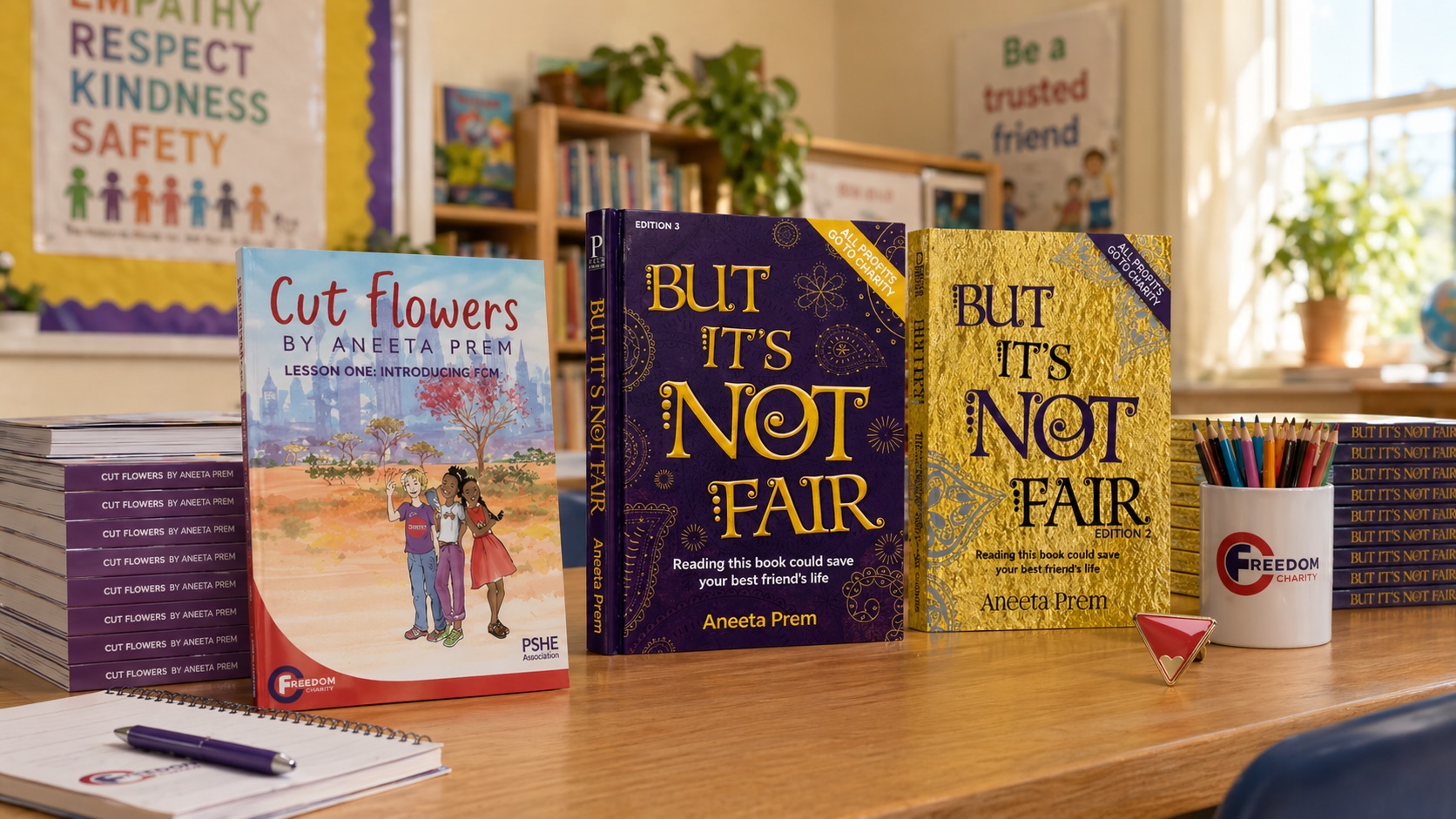
Freedom Charity uses But It’s Not Fair and Cut Flowers to help young people understand forced marriage, FGM, pressure, fear and safe routes to help. Freedom’s site explains that Cut Flowers helps young people understand FGM, the dangers, and what they can do to help prevent it.
That matters because formal safeguarding language may not come first. Recognition often does.
Stories give children safer language
A story can help children understand difficult subjects without making them feel blamed or exposed.
Legal definitions matter. However, a child may first recognise pressure through a character, a family situation, a friend’s worry or a moment of unfairness.
That can become the first step towards asking for help.
In practice, a book can help a pupil say:
“I think this is happening to me.”
“I am worried about my friend.”
“I did not know I could ask for help.”
“I thought I had no choice.”
Those sentences can change what happens next.
Forced marriage must be understood clearly
Forced marriage is illegal in the UK. GOV.UK explains that forced marriage means a marriage where one or both people do not or cannot consent, and pressure or abuse takes away free choice.
GOV.UK also says forced marriage includes doing anything to make someone marry before they turn 18, even if nobody uses pressure or abuse.
This is important for schools because children may not use legal terms.
A pupil may say:
“My family says I have to marry.”
“I am being taken abroad.”
“I do not want to shame them.”
“They say I have no choice.”
“I am scared to go home.”
Adults should not dismiss those comments as ordinary family tension. They may be safeguarding warning signs.
FGM must never be softened
Female genital mutilation is also a safeguarding issue.
The NHS explains that FGM involves cutting, injuring or changing the female genitals without medical reason. It says FGM usually affects young girls between infancy and the age of 15, most commonly before puberty starts.
The NHS also says FGM has no health benefits and can cause serious harm.
For that reason, adults must never soften FGM or hide it behind words such as culture, purity, family honour or tradition.
A girl’s body is not family property. A child’s safety must come first.
How Cut Flowers helps young people
Cut Flowers helps young people approach FGM through story.
Freedom Charity’s site describes the book as an informative and engaging resource that helps young people understand the dangers of FGM and what they can do to help prevent it.
That is important because children may find FGM difficult to discuss openly.
A story can reduce silence. It can help pupils understand that FGM is harmful, illegal and not their fault. It can also help friends recognise when they should speak to a trusted adult.
For schools, the book does not replace safeguarding procedures. Instead, it supports careful teaching and early recognition.
How But It’s Not Fair helps young people
But It’s Not Fair helps young people understand forced marriage, family pressure and the difference between choice and coercion.
Freedom’s shop page describes But It’s Not Fair as Aneeta Prem’s debut novel and an easy-to-read, informative book on forced marriage and different cultures.
This matters because children often understand fairness before they understand the law.
A pupil may not be able to explain consent, coercion or safeguarding. However, they can often understand when something feels wrong, frightening or unfair.
That recognition can help them speak.
Books and PSHE resources work together
Freedom Charity’s PSHE resources give schools structured lesson plans on forced marriage and FGM.
Freedom’s PSHE Educational Resources page states that, in liaison with Freedom Charity, the PSHE Association produced separate accredited lesson plans, with teachers’ notes and accompanying resources, on forced marriage and FGM.
Freedom’s PSHE page also says the Key Stage 3 and 4 resources received the PSHE Association Quality Mark and complement Cut Flowers and But It’s Not Fair.
That combination is powerful.
Lesson plans give teachers structure. Books give pupils a human way into difficult subjects. Together, they help schools move from silence to safe, practical education.
Why schools should use forced marriage and FGM books for schools
Schools often notice risk first.
A teacher may see anxiety before a holiday. A tutor may hear a comment about marriage. A friend may disclose concern before the child at risk feels ready to speak.
Therefore, schools need more than policy documents. They need tools that pupils can understand.
Forced marriage and FGM books for schools can help pupils recognise pressure, fear, secrecy and control. They can also help teachers start careful conversations before a child reaches crisis.
That is safeguarding with purpose.
Why donors and grant-givers should support books in schools
Books offer practical prevention.
When donors support book donations, they help place safeguarding language into classrooms, libraries and youth settings.
A book can stay on a shelf after a lesson ends. It can be read quietly. It can be shared with a friend. Importantly, it can give a child the courage to ask one important question.
For grant-givers, this gives Freedom Charity a clear prevention model:
children receive age-appropriate safeguarding education
teachers receive resources they can use
schools strengthen early recognition
young people learn safe routes to help
Freedom Charity reaches more pupils before harm occurs
Prevention is cheaper, kinder and safer than crisis.
Help Freedom put books into more schools
Freedom Charity works to protect children and young people from forced marriage, FGM and dishonour abuse through education, books, lesson resources awarded the PSHE Association Quality Mark, public awareness and practical support.
Your support can help more schools access clear, careful and credible safeguarding education.
Donate to Freedom
Request PSHE Resources
Sponsor Books for Schools
Book a School Visit
Buy a Red Triangle Badge
Sources
Freedom Charity: Cut Flowers
Freedom Charity: But It’s Not Fair
Freedom Charity: PSHE Educational Resources
Freedom Charity: PSHE Association accredited resources
GOV.UK: Forced marriage guidance
NHS: Female genital mutilation
About the author
Written by Aneeta Prem, Founder of Freedom Charity.
Freedom Charity works to protect children and young people from forced marriage, FGM and dishonour abuse through education, safeguarding resources, books, public awareness and practical support.