



 Forced Marriage and FGM Holiday Risk: What Schools Must Notice Before the Break
School holidays can increase forced marriage and FGM holiday risk. For some children, the signs appear before the break. When adults miss them, a pupil may not return to school, or may come back having already suffered serious harm.
Current safeguarding guidance makes clear that concerns linked to forced marriage, FGM and children missing education are child protection matters, not routine pastoral or attendance issues.
We talk a great deal about summer. We should talk much more seriously about Easter too.
Summer may be the crisis point. Easter is often the warning point.
That distinction matters. If a child disappears after a holiday, the safeguarding failure often happens before they leave. By the time the register shows that a pupil has not returned, the real opportunity to protect them may already have passed. A flight may have gone. A marriage may have taken place. A girl may already have been cut.
Forced marriage and FGM holiday risk in the UK
Forced marriage and female genital mutilation are both forms of abuse. Government guidance defines forced marriage as a situation in which one or both people do not, or cannot, consent and pressure or abuse is used. Where someone makes a child marry before 18, the law classifies it as forced marriage even without proof of pressure. FGM is illegal in the UK, and professionals must follow the statutory safeguarding framework.
This is not a theoretical issue. The latest Forced Marriage Unit statistics show 812 contacts in 2024 relating to possible forced marriage or possible FGM. The FMU gave advice or support in 240 cases. Among those cases, 15 per cent involved children aged 15 and under, while 19 per cent involved 16 to 17-year-olds. Social services, police and education professionals were all among the referral sources.
During school holidays, children lose daily contact with trusted adults. Travel plans may move ahead with limited scrutiny. Disclosure opportunities can narrow. Family pressure can intensify as term ends. Professionals should therefore never treat holiday risk as a seasonal awareness slogan. It is a safeguarding issue that demands early attention, sound judgement and prompt action.
Why Easter increases forced marriage and FGM holiday risk
Most public messaging focuses on the long summer break. That is understandable, but it is not enough.
Easter often appears earlier in the safeguarding chain. At that stage, a child may first become visibly anxious. Family plans may begin to form. A teacher, friend, designated safeguarding lead, school nurse or pastoral worker may still have time to ask the right question and record the right concern.
If professionals think only in terms of summer, they may notice some children too late.
Recognising forced marriage and FGM holiday risk before school breaks
Warning signs do not come with labels. A child is unlikely to say clearly and confidently that she fears forced marriage or FGM. More often, adults see fragments.
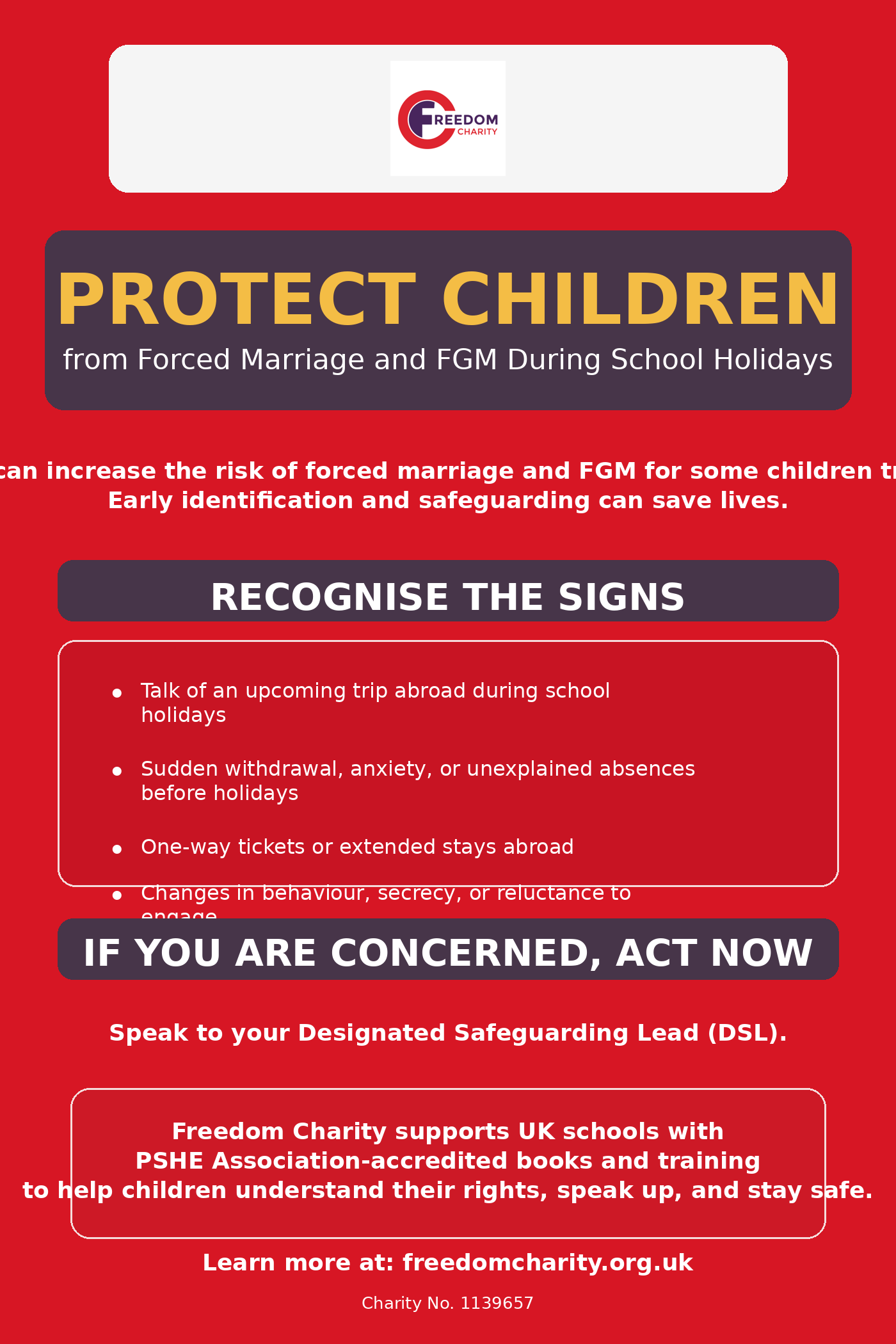
Schools and frontline professionals should look out for signs such as:
- sudden anxiety about a family holiday or overseas trip
- requests for leave that do not fit the usual pattern
- talk of a special ceremony, engagement, wedding or family obligation
- fear about the end of term
- unusual secrecy, distress or withdrawal
- a child appearing frightened about going home or travelling
- behaviour suggesting control, obedience, surveillance or pressure linked to family honour
- concerns about a child being taken abroad or not returning to education after a school break
No single sign proves abuse on its own. However, several signs taken together may point to serious risk. School safeguarding guidance makes clear that staff must know their reporting systems, raise concerns promptly and support referrals where harm may occur. Every school should also have a designated safeguarding lead who supports staff and works with other agencies.
Student not returning after holiday safeguarding
A student who does not return after a holiday may look, at first glance, like an attendance problem. In reality, it may be a child protection issue linked to forced marriage, FGM or another form of hidden abuse.
That distinction is critical. If a school begins with attendance processes alone, it may already be behind. Staff should not treat a child who does not return after a holiday as a routine absence until they have answered safeguarding questions. Government guidance on forced marriage specifically addresses cases where someone may have been taken abroad or is due back and does not return as expected.
Before a holiday, the adult a child speaks to may be the last trusted person with a realistic chance to act.
Why delay increases safeguarding risk
Delay is not neutral. In these cases, delay can close the final window in which a child can still be protected.
The system often talks about legal tools and court orders. Those tools matter. However, they usually come into play after professionals identify risk. Prevention starts earlier. It starts when a child understands that something is wrong, and when the adult hearing or seeing that concern knows what to do next.
National safeguarding guidance places a clear duty on agencies to work together, protect children and act when they identify concerns of significant harm.
That is why schools matter so much. They are often the last ordinary place where risk can be seen before a child disappears from view.
What schools should do
If staff notice warning signs, they should not wait for certainty. They should:
- record concerns clearly and factually
- follow internal safeguarding procedures without delay
- alert the designated safeguarding lead
- treat travel risk seriously
- consider whether the child may face forced marriage or FGM risk
- seek specialist advice where needed
- make appropriate referrals to children’s social care or the police where the risk justifies it
Doing nothing is not a neutral response. If a child makes even a partial disclosure, minimising it or waiting for firmer proof can become the decision that leaves her unprotected.
Why children need the words before crisis
Children cannot describe abuse clearly if nobody has ever given them the language to describe it.
That is why school-based education matters. It is not an optional extra. It remains one of the few places where prevention still has a real chance to work.
A child may not say, “I am at risk of forced marriage,” or, “I fear FGM.” Instead, she may describe fear, travel, secrecy, pressure, shame or family expectation. Sometimes she may only half-tell the truth. Without language that helps her understand abuse, even that may not happen.
Girls need language before they need lawyers. Professionals need confidence before they need a court order.
PSHE resources for forced marriage and FGM
Freedom Charity provides PSHE-accredited lesson plans and resources to help schools address forced marriage and FGM clearly, safely and at the right age.
That includes books such as But It’s Not Fair and Cut Flowers, which help children recognise abuse, understand coercion and seek help earlier. Used properly, these are not decorative classroom resources. They form part of prevention. They help create the language that makes disclosure possible.
Children need materials that do more than raise awareness. They need resources that help them recognise secrecy, control, pressure and fear for what they are.
Forced marriage training for schools
Schools, DSLs, teachers, social workers, police, health staff, parents and friends all need confidence as well as concern.
Freedom Charity offers practical support through books, PSHE lesson plans, specialist training, a helpline and an app. This matters because legal tools alone do not keep children safe. Adults who recognise risk early, ask the right questions and act without delay can change the outcome of a child’s life.
Why this work needs funding
If the UK is serious about protecting girls, it must fund not only the legal response after risk is identified, but also the school-based education, specialist training and frontline support that help children and professionals recognise abuse before harm is done.
Prevention cannot depend on goodwill alone.
A court order may be vital. However, it cannot replace the missed conversation, the unasked question, the untrained teacher or the child who never had the words to describe what was happening.
That is why funding specialist school work, safeguarding education, books, training, helpline support and accessible tools for children is not secondary. It is part of protection itself.
Where to get help
If you are worried about a child at risk of forced marriage or FGM, support is available.
Freedom Charity provides:
- specialist support
- training and advice
- school resources
- a helpline
- practical safeguarding help
Where there is an immediate risk of harm, schools and professionals should follow safeguarding procedures, contact children’s social care or the police as appropriate, and use the national forced marriage and FGM guidance where relevant.
Final point
Forced marriage and FGM holiday risk should not be treated as something that begins only in summer. Often, the signs appear earlier. In many cases, the chance to act is smaller than adults realise.
If a student does not return after a holiday, schools must ask why. If a child shows fear before a break, adults must take that seriously. If we want fewer children to disappear from education or return from a holiday changed for life, we must act before they leave.
Aneeta Prem London 30 April 2026