




Forced Marriage Figures 2025: why children are still at risk
By Aneeta Prem MBE, Founder of Freedom Charity
The Forced Marriage Figures 2025 show why children remain at serious risk in the UK. The latest Forced Marriage Unit statistics are not simply a set of numbers. They show how late professionals identify many victims, how hidden this abuse remains, and why early recognition still matters.
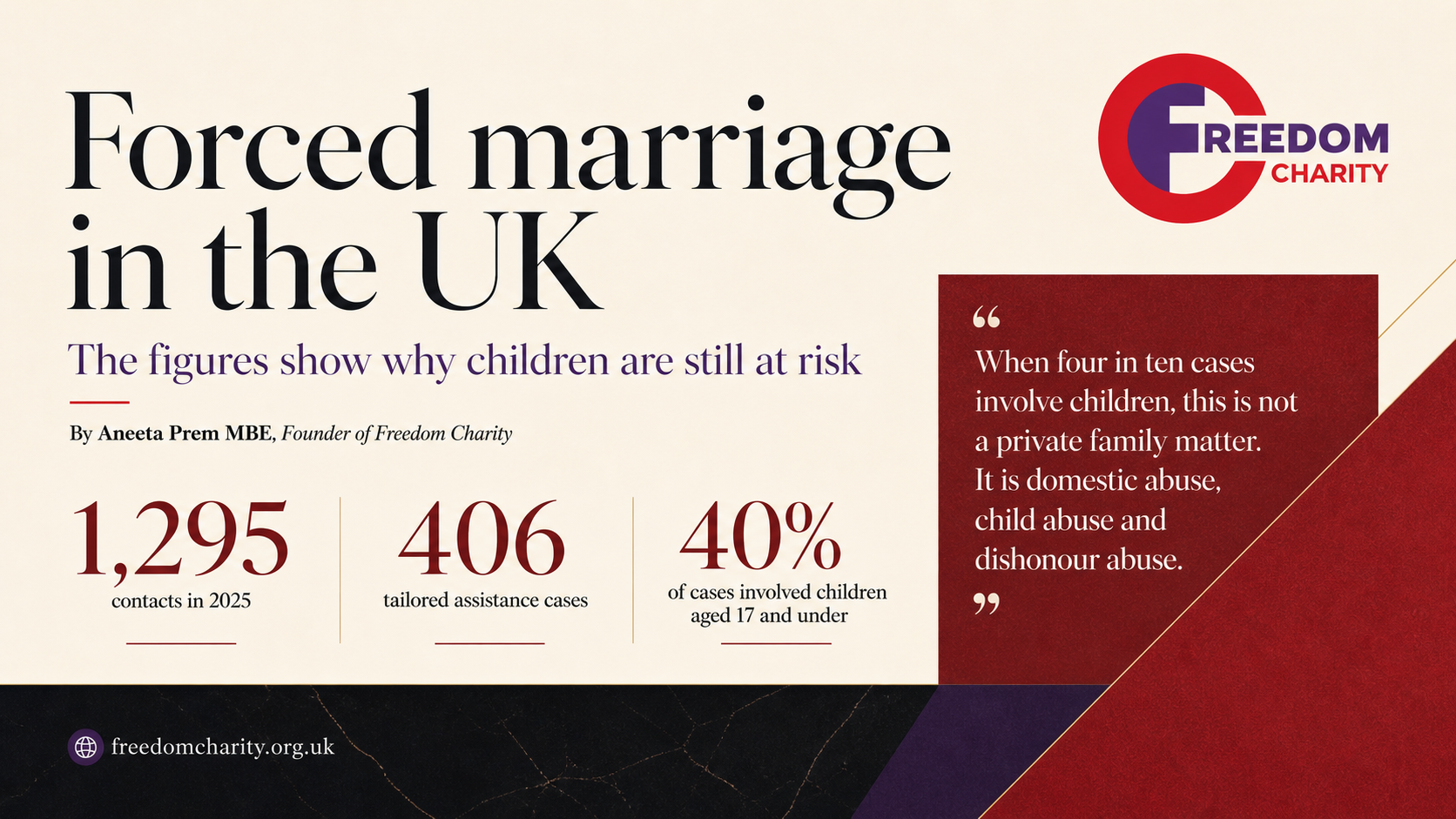
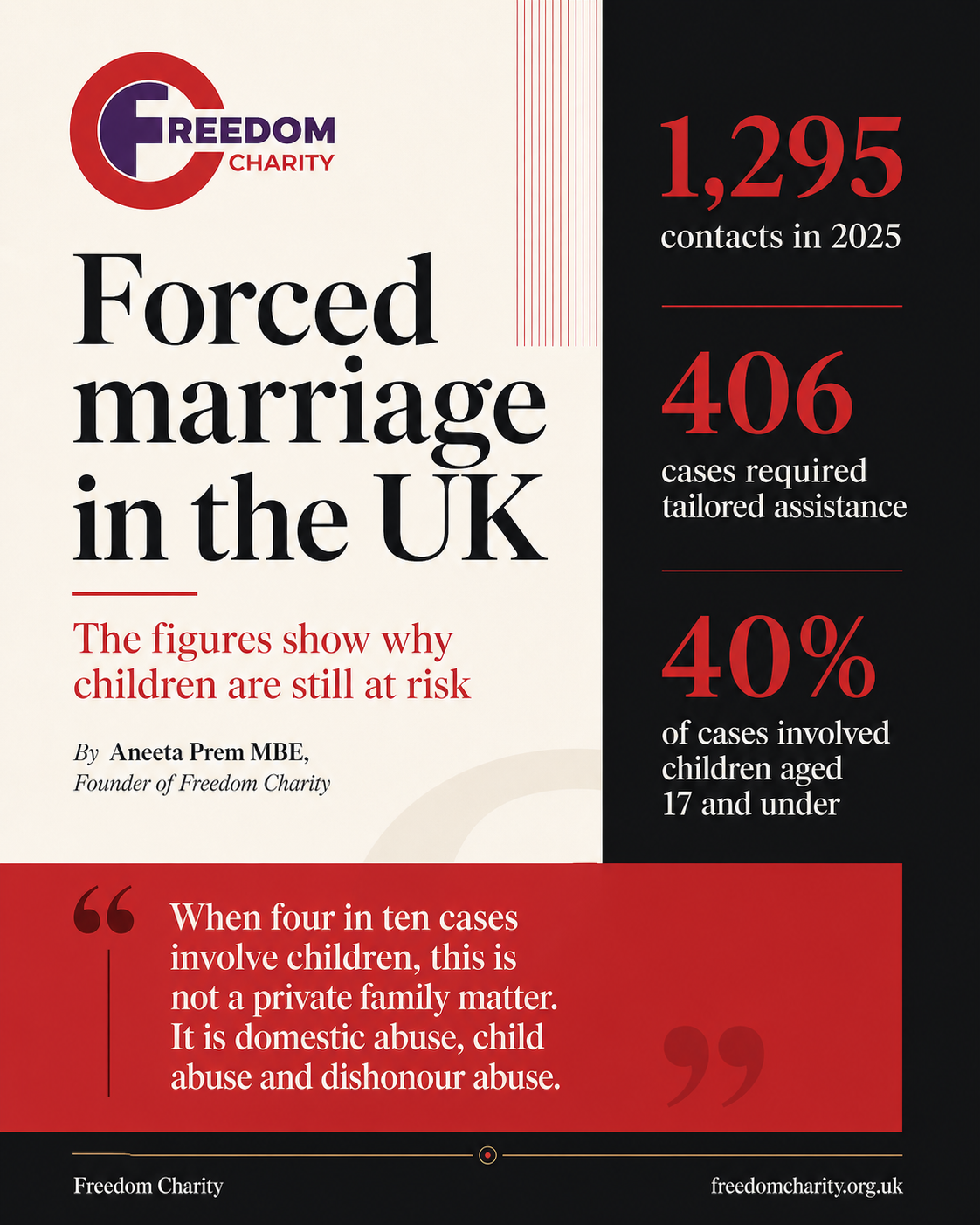
In 2025, the Forced Marriage Unit received 1,295 contacts relating to possible forced marriage or female genital mutilation. The unit provided tailored assistance in 406 cases. The Government says these figures do not show the full scale of abuse. Many cases never reach the system.
How to read the 2025 data: The Home Office published these figures on 28 April 2026. The 1,295 contacts comprised 406 tailored-assistance cases (391 involving forced marriage and 15 involving FGM) and 889 enquiries. Percentages quoted below, including the 40% involving children, use 406 cases as their denominator. The figures do not measure the prevalence of forced marriage, and changes in recording practices mean comparisons with earlier years need care. Read the official statistics and methodology.
The most important figure is this: 40% of tailored assistance cases involved children aged 17 and under.
That is not a marginal issue. It is child protection.
“When four in ten cases involve children, this is not a private family matter. It is domestic abuse, child abuse and dishonour abuse.”
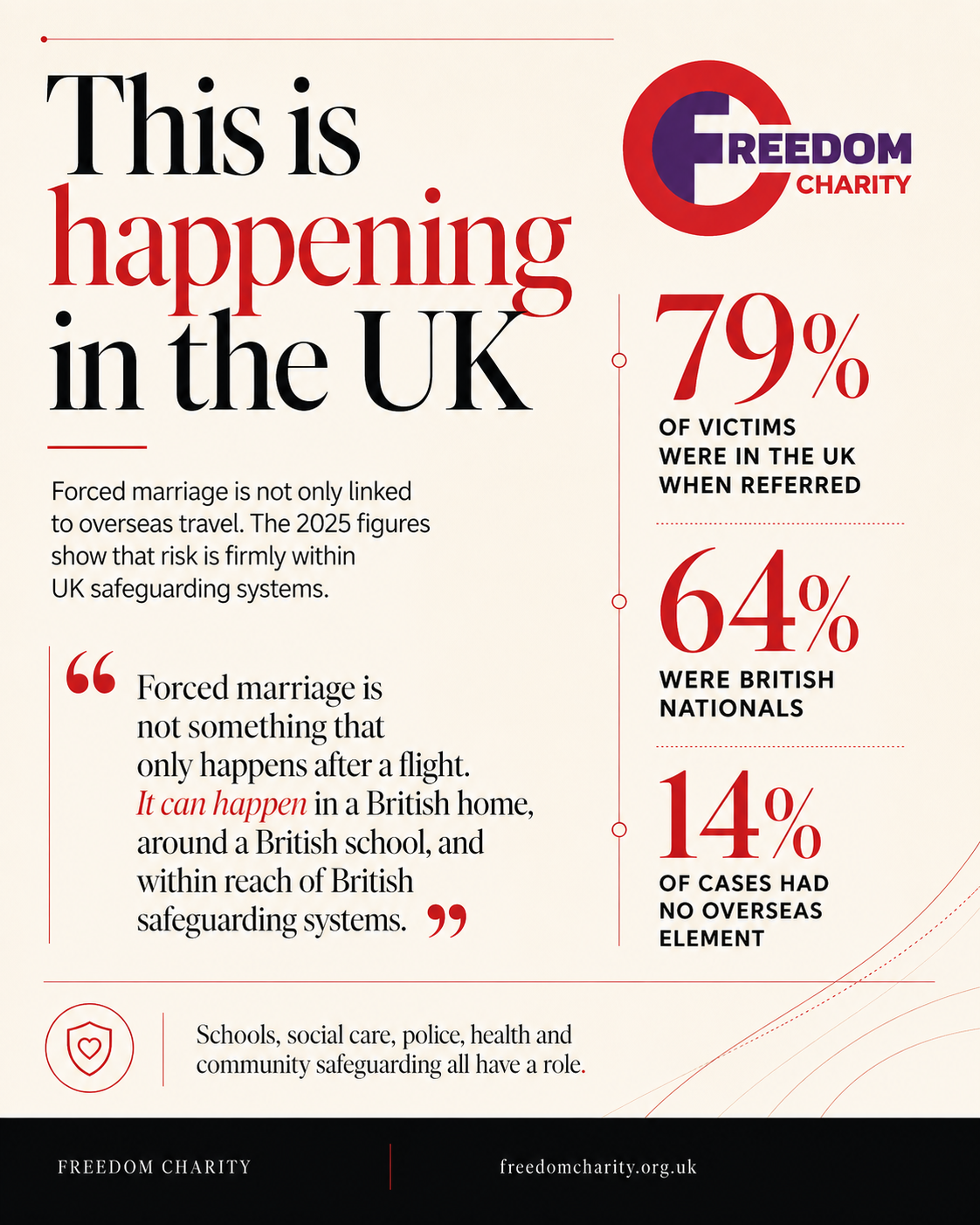
This is happening in the UK, not just overseas
Many people still assume forced marriage mainly involves travel abroad. The 2025 data challenges that view.
For definitions, warning signs, the difference between arranged and forced marriage, UK law and routes to support, see Freedom Charity’s main forced marriage guide.
In 2025, 79% of victims were in the UK when someone referred their case, 64% were British nationals, and 14% of cases had no overseas element at all.
“Forced marriage is not something that only happens after a flight. It can happen in a British home, around a British school, and within reach of British safeguarding systems.”
These figures place responsibility firmly within UK services: schools, social care, police, health and community safeguarding.
 Children rarely report it themselves
Only 14% of cases came directly from victims. Professionals, including social workers, police and education staff, made many of the other referrals.
This matters because many victims cannot safely ask for help. Some do not recognise what is happening. Fear also keeps many silent.
“A child may not say they are at risk of forced marriage. They may say they are frightened of a family trip, worried about bringing shame on relatives, or scared of what will happen if they refuse.”
Professionals must recognise those signs early.
Schools can see what others miss
Despite the high proportion of child victims, education professionals made only 6% of referrals.
That does not mean schools are failing. It raises a harder question: do all schools have the training and confidence to recognise forced marriage and FGM?
“A school may be the only place where a child is seen away from family pressure. A teacher may be the only adult who notices a change in behaviour, fear around travel, or sudden absence.”
Early recognition in schools can prevent harm before it escalates. Freedom Charity’s PSHE educational resources help schools approach forced marriage and FGM safely, clearly and within a safeguarding framework.
Boys and men must not be overlooked
The data shows that 74% of victims were female and 26% were male. It also shows that men featured strongly in cases involving mental capacity concerns.
“Forced marriage harms girls and women disproportionately, but boys and men can also be victims. If professionals only look for one type of victim, they will miss others.”
Good safeguarding must reflect the full reality of who faces risk.
Disability and mental capacity are central, not secondary
The FMU recorded 75 cases involving victims whose mental capacity to consent to marriage was in doubt.
This raises one of the most serious safeguarding concerns. Families or others may use marriage to manage care, control behaviour, or shift responsibility for a vulnerable person.
That is not marriage. It is exploitation.
“Mental capacity goes to the heart of consent. If a person cannot freely choose, marriage cannot be used as a solution to care, pressure or expectation.”
Forced marriage does not end at the ceremony
Coercion can continue after marriage. The figures include “reluctant sponsor” cases, where people face pressure to support visa applications.
“Forced marriage is not a single event. It is a pattern of control that can continue long after the ceremony.”
Professionals may wrongly assume the risk has passed once a marriage has taken place. In reality, coercion can continue through immigration pressure, sexual violence, financial control, isolation, threats and family intimidation.
The most serious risks must be named
Forced marriage is a form of dishonour abuse. In the most serious cases, patterns of coercion and control may lead to sexual violence, serious harm and homicide.
Government guidance describes forced marriage as a criminal offence, child abuse, domestic abuse and a form of violence against women and men.
“There is no honour in coercion, control or abuse. Naming it clearly matters.”
Forced marriage is a crime
Forced marriage is illegal in England and Wales. The law makes it an offence to force someone to marry. It also covers deception intended to make someone leave the UK so others can force them into marriage overseas.
Courts can make a Forced Marriage Protection Order to protect someone facing forced marriage or someone already forced into marriage.
The legal position is clear. The challenge lies in whether children, families and professionals recognise the risk early enough.
Why early prevention matters
The data shows that professionals identified 62% of cases before the marriage took place. That means early action can prevent harm.
“Every early referral is a chance to prevent harm. Once a marriage has taken place, the risks and consequences can deepen.”
Prevention must not wait until a child reaches the airport, disappears from school, or becomes trapped in a marriage. The safest intervention often happens before crisis.
Why Freedom Charity focuses on schools
The Forced Marriage Figures 2025 explain why Freedom Charity centres its work on early prevention.
Through PSHE Association quality-assured lesson plans, books such as But It’s Not Fair and Cut Flowers, the Freedom Charity app and helpline support, Freedom Charity helps children, teachers and professionals recognise risk before crisis.
Freedom Charity’s school resources help educators explain the difference between arranged marriage and forced marriage, identify warning signs, understand the law, and respond safely when a child may face risk.
“A child may not have the language to describe what is happening. Education gives them the words before crisis.”
The real meaning of the Forced Marriage Figures 2025
The Forced Marriage Unit statistics show the cases that reached the system.
They do not show how many professionals missed.
“The FMU figures show the cases that reached the system. Freedom Charity’s work is about reaching the child before that point.”
That is the central lesson from the Forced Marriage Figures 2025. Children need safe adults, informed teachers, trained professionals and routes to help before abuse becomes irreversible.
If you are worried about someone
If you worry that someone may face forced marriage or FGM, seek advice from a safeguarding professional or contact Freedom Charity for support.
If someone is in immediate danger, call 999.
Schools and professionals can also access Freedom Charity’s PSHE educational resources and school training information.