



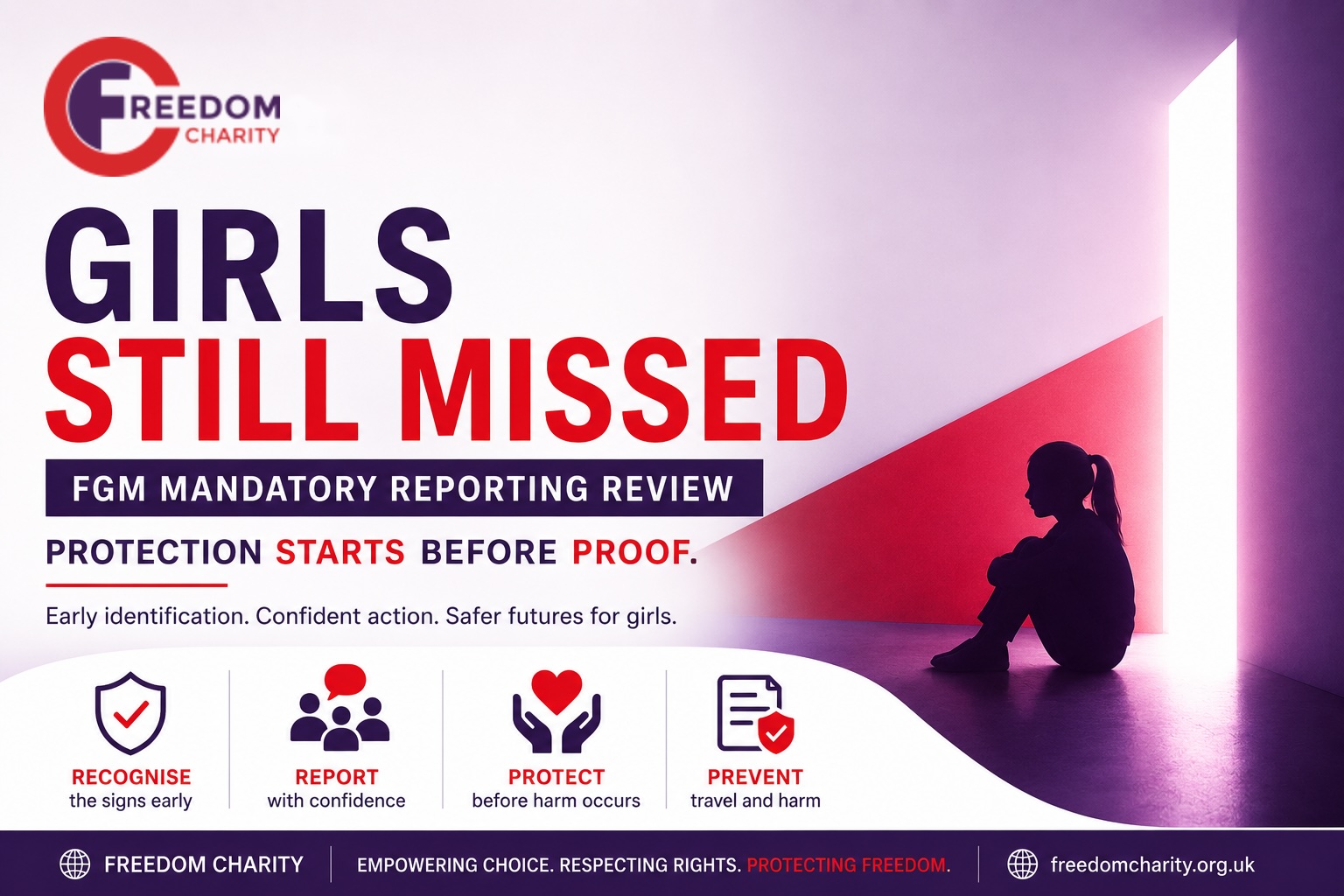
 Girls Still Missed
Why FGM mandatory reporting alone does not keep children safe
FGM mandatory reporting matters, but legal duties alone cannot keep girls safe unless professionals recognise risk early. The Home Office review should not sit in a narrow policy box. It should test whether the safeguarding system identifies girls before travel, before silence, and before harm becomes visible.
On 30 April 2026, the Government announced new measures after the first dedicated FGM Summit in a decade. These included a review of the mandatory reporting duty, further work on Female Genital Mutilation Protection Orders, earlier police and CPS action in cases, and additional professional training. The stated aim is to strengthen protection for women and girls at risk of FGM.
That aim matters. However, the harder question comes before any report reaches the police.
A mandatory duty only works when someone recognises danger. The real safeguarding test is whether professionals notice warning signs before a girl disappears from view, before travel, before silence, and before harm becomes visible.
Read Freedom Charity’s guidance on FGM
What FGM mandatory reporting requires
FGM is a criminal offence. The CPS describes it as a form of violence against women and girls and, when it affects children, child abuse.
In England and Wales, FGM mandatory reporting applies to regulated health and social care professionals and teachers. It requires them to report known cases of FGM in girls under 18 to the police when they identify those cases through their professional work. The duty came into force on 31 October 2015.
That duty matters. But it cannot carry the whole safeguarding system.
Known cases trigger mandatory reporting. Suspected risk still requires professional judgement. A girl may face danger because of travel plans, family pressure, sudden withdrawal, indirect comments or behaviour that signals fear.
No child should have to be harmed before the system feels confident enough to act.
Read the Government guidance on FGM mandatory reporting
Why FGM mandatory reporting is not enough
FGM often hides behind silence, travel, fear and family control. A child may not know the term FGM. She may not understand what adults have planned. She may only know that she feels frightened.
Sometimes the signs look quiet.
A sudden trip abroad. A “special ceremony”. A long absence from school. Relatives arriving from overseas. A girl becoming anxious, withdrawn or unusually silent. A child saying she does not want to go away.
None of those signs proves FGM. Each one requires safeguarding curiosity.
Systems fail when professionals hesitate. They wait for clearer evidence. They fear saying the wrong thing. They worry about cultural sensitivity. Yet uncertainty may be the only warning anyone receives.
This is why FGM mandatory reporting must sit inside a wider safeguarding culture. Professionals need the confidence to act on risk, not only confirmed harm.
Read Freedom Charity’s forced marriage guidance
Why holiday safeguarding matters
The period before school holidays gives professionals one of the most important safeguarding windows.
Schools may be the last protective setting to see a child before she travels. Teachers may notice a change in behaviour. Friends may hear something worrying. Attendance staff may spot a pattern. A Designated Safeguarding Lead may connect several small signs into one serious concern.
For that reason, the review of FGM mandatory reporting must not focus only on what happens after someone identifies FGM. It must also ask whether professionals know how to act while the risk is still forming.
Protection starts before proof.
Read Freedom Charity’s article on forced marriage and FGM books for schools
Why reporting is not the same as protection
A report to the police may be necessary. In an emergency, professionals should call 999. For known cases under the mandatory duty, professionals must follow the reporting process.
However, safeguarding must never become a box-ticking exercise.
Reporting forms one part of protection. It must sit alongside:
- early identification
- clear recording
- safe escalation
- careful information-sharing
- specialist advice
- protection orders where appropriate
- action before travel where risk appears immediate
FGM Protection Orders can protect someone who has already experienced FGM or someone who faces risk. The court can tailor conditions to the case and, where needed, use orders to help prevent travel or contact.
Legal tools exist. The real question is whether professionals use them early enough.
Read the Government guidance on FGM Protection Orders
FGM mandatory reporting needs professional confidence
Confidence sits at the centre of this issue.
A teacher should know what to do if a girl mentions a ceremony. A nurse should know how to respond when risk signs appear. A GP should not dismiss anxiety around travel. Police should recognise that FGM may overlap with forced marriage, domestic abuse, trafficking, immigration control or other forms of family coercion.
Professionals should never soften FGM into a cultural misunderstanding. It is abuse.
At the same time, safeguarding must remain precise and lawful. Professionals must not stereotype families or communities. They should identify risk, record facts, ask appropriate questions and follow safeguarding procedures.
That balance requires training. It also requires courage.
Read CPS guidance on Female Genital Mutilation
Why Freedom Charity’s work matters
Freedom Charity works with schools, young people, families and professionals to prevent forced marriage, FGM and dishonour abuse before crisis point.
Our work focuses on education and early intervention. Through our books, lesson plans, school sessions, training and whole-school approach, we help children and professionals recognise coercion, understand risk and know where to get help.
This work matters because a child at risk may not disclose in direct language. She may speak through fear, absence, behaviour or silence.
Safeguarding professionals need to hear that language before harm happens.
Support Freedom Charity’s Red Triangle Badge against FGM
What the FGM mandatory reporting review should ask
A serious review of FGM mandatory reporting should ask more than whether the duty exists.
It should ask:
- Do teachers understand when the mandatory duty applies?
- Do they know what to do when FGM is suspected but not confirmed?
- Are schools identifying travel-related risk before holidays?
- Do NHS staff know how to respond to indirect signs?
- Can professionals escalate concerns without stereotyping?
- Are FGM Protection Orders considered early enough?
- Do police, schools, health and social care work together before risk becomes a crisis?
- Are girls protected before they disappear from view?
These are the questions that matter.
What schools and professionals should do now
Schools and frontline professionals should not wait for the review to conclude before strengthening practice.
They should:
- refresh staff understanding of FGM warning signs
- brief Designated Safeguarding Leads before holiday periods
- review unexplained absences and sudden travel plans
- make sure staff know the difference between known FGM and suspected risk
- avoid approaching family members where this may increase danger
- seek safeguarding advice early
- consider whether an FGM Protection Order may be needed
- call 999 if a child faces immediate danger
This is not suspicion without evidence. It is the careful recognition of patterns before harm occurs.
Read NSPCC guidance on protecting children from FGM
The uncomfortable truth about FGM mandatory reporting
FGM mandatory reporting matters. But it is not enough.
A duty to report known FGM cannot protect a girl who remains unseen, unheard, unasked or unbelieved.
The real test is whether professionals act when the signs are still quiet.
Girls are still being missed.
That is why the review matters.
And it is why safeguarding must begin before harm becomes visible.
Getting help
If a child is in immediate danger, call 999.
If you are worried about FGM, forced marriage, dishonour abuse or coercive control, speak to a trusted safeguarding professional or specialist organisation.
Freedom Charity provides information and support for children, young people, families and professionals affected by forced marriage, FGM and dishonour abuse.
FAQs
What is FGM mandatory reporting?
FGM mandatory reporting is a legal duty in England and Wales. It requires regulated health and social care professionals and teachers to report known cases of FGM in girls under 18 to the police when they identify the case through their professional duties.
Does FGM mandatory reporting apply to suspected risk?
The mandatory reporting duty applies to known cases. However, suspected risk must still trigger safeguarding action. Professionals should follow safeguarding procedures, seek advice and act where a child may face danger.
Why is the Home Office reviewing FGM mandatory reporting?
The Government announced a review as part of wider measures to strengthen protection for women and girls from FGM. The announcement followed the national FGM Summit on 30 April 2026.
What signs may suggest a girl is at risk of FGM?
Possible warning signs include anxiety about travel, references to a special ceremony, relatives arriving from overseas, sudden withdrawal, unexplained absence from school, or a child saying she does not want to go away.
What should schools do before holidays?
Schools should brief staff, review travel-related concerns, monitor absence patterns, listen carefully to indirect disclosures, escalate safeguarding concerns early and seek specialist advice where needed.
Can an FGM Protection Order help before harm occurs?
Yes. An FGM Protection Order can help protect someone who has already experienced FGM or someone who is at risk.
Sources
- GOV.UK: Mandatory reporting of female genital mutilation
- GOV.UK: Female Genital Mutilation Protection Orders
- CPS: Female Genital Mutilation
- NSPCC: Protecting children from FGM
About the author
Aneeta Prem MBE is the founder of Freedom Charity and a long-standing campaigner on forced marriage, FGM, dishonour abuse and safeguarding. Freedom Charity works with children, young people, families, schools and professionals to prevent abuse through education, early intervention and practical support.