Honour Based Abuse and Dishonour Abuse: Why Words Save Lives
People search for honour based abuse, and many professionals also search HBV (honour-based violence), because that is the language used in headlines, systems and policy. However, the phrase carries a built-in distortion. The word “honour” sits beside abuse, as if the two can belong together.
At Freedom Charity, we call it what it is: Dishonour Abuse. There is no honour in coercion, control, threats, forced marriage, FGM, or violence. Power is the motive. Fear is the outcome.
This page keeps the search term people use, because findability can save lives. It also corrects the framing, because accuracy protects survivors.
For journalists and producers covering HBV and honour based abuse
If you are reporting on HBV (honour-based violence), honour based abuse, forced marriage, FGM, or safeguarding failure, you can cite this page and our framing: Dishonour Abuse.
Freedom Charity position: there is no honour in abuse.
Fast briefing you can use:
-
Dishonour Abuse is often multi-perpetrator, with collusion and surveillance.
-
Family contact and mediation can escalate risk, so practice must be disciplined.
-
The law already covers the conduct, so focus should stay on coercion, threats, control, and harm.
Press contact: use Freedom Charity’s contact route and include your deadline in the message.
https://freedomcharity.org.uk/contact-us/
Quick definition: HBV and honour based abuse
Honour based abuse is a pattern of intimidation, threats, coercion, control and violence. A perpetrator may claim they are preventing “shame” or restoring “family reputation”.
In reality, this is Dishonour Abuse, because shame belongs to the abuser and any colluders, not to the survivor.
One person can carry it out. Multiple perpetrators or enablers are more common. Risk can escalate quickly, and it can also remain hidden for years.
Why the words matter
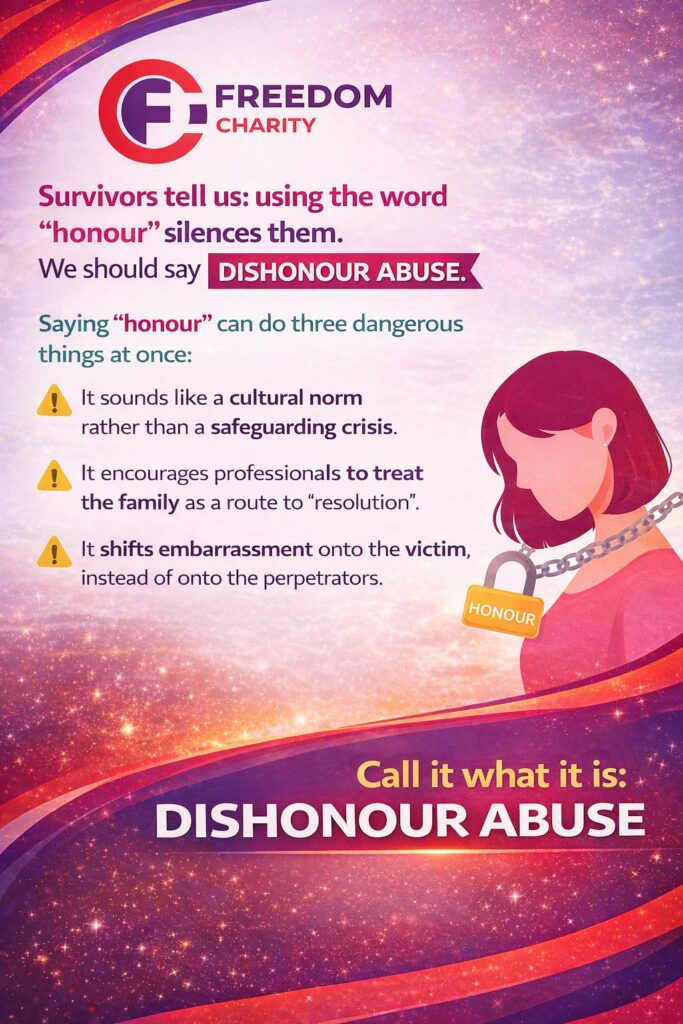
Survivors tell us the same thing in different ways: the word “honour” can silence them. That language can also mislead the public and professionals at the exact moment when clarity matters most.
The word can do three dangerous things at once. First, it can sound like a cultural norm rather than a safeguarding crisis. Next, it can encourage professionals to treat the family as a route to “resolution”. Finally, it can shift embarrassment onto the survivor instead of onto the perpetrators.
That is why Freedom Charity insists on Dishonour Abuse. The term places moral responsibility back where it belongs. Professional responsibility becomes clearer too, because this is abuse and it demands safeguarding action.
HBV in policy: what prosecutors and Parliament mean by “so-called honour”
Public bodies often use the phrase “so-called honour-based abuse”. That wording matters because it rejects the idea that “honour” is a valid explanation.
Crown Prosecution Service guidance is clear that cases are prosecuted for the offences committed, while being flagged as so-called honour-based abuse where relevant.
https://www.cps.gov.uk/prosecution-guidance/so-called-honour-based-abuse
For wider context, the CPS overview page is also useful for journalists and professionals.
https://www.cps.gov.uk/types-crime/violence-against-women-and-girls/honour-based-abuse
What Dishonour Abuse looks like on the ground
Dishonour Abuse often presents as a tightening circle. A survivor may not call it abuse at first. Instead, they describe pressure, panic, monitoring, fear, or “family problems”.
Common signs include:
-
Sudden restrictions on movement, education, friendships, clothing, phone use, or money.
-
Surveillance by siblings, cousins, community members, or adults acting as enforcers.
-
Threats linked to shame, reputation, marriage prospects, or community standing.
-
Warnings not to disclose anything to teachers, GPs, the police, social workers, or friends.
-
Escalation after a trigger, such as refusing a marriage, ending a relationship, seeking a divorce, reporting abuse, choosing education, or being LGBTQ+.
Importantly, honour based abuse can be engineered to look like “choice”. Compliance may be a safety strategy rather than consent.
The most dangerous professional mistake: family contact and mediation
Many safeguarding models assume parents are safe partners. Dishonour Abuse cases can punish that assumption.
Where the family system is part of the control, contact can increase danger. A disclosure can trigger rapid escalation and punishment. In addition, it can increase the risk of removal from school or services, forced travel, or violence.
Specialist safeguarding practice matters here. Safe enquiry, careful recording, and multi-agency routes reduce risk. Improvisation can do the opposite.
Where the law already bites in England and Wales
Dishonour Abuse is not one offence. It is a pattern of offences. Depending on the facts, it can include:
-
controlling or coercive behaviour
-
harassment, stalking, and threats
-
assault and sexual offences
-
child cruelty and neglect
-
forced marriage and related offences
-
FGM and related offences
-
false imprisonment, abduction, or kidnapping
-
image-based abuse used to blackmail or silence
-
forced travel or abandonment overseas
The legal point is simple. Culture does not need to be proven. Conduct, coercion, intent, and harm are what matter.
For prosecutors and investigators, the CPS guidance on forced marriage and related offending is also relevant.
https://www.cps.gov.uk/legal-guidance/forced-marriage-and-related-offences
A practical tool professionals can use: the Dishonour Index
Headline terms can hide harm. That is one reason survivors fall through cracks.
Freedom Charity’s Dishonour Index focuses on behaviours beneath the label, including surveillance, collusion, escalating threats, and control that may not leave visible injury. It also recognises how perpetrators may use systems, family networks, and “reputation” narratives to pressure compliance.
In practice, early warning signs are often administrative and behavioural, not medical. Sudden travel talk, school withdrawal, device control, and intensified monitoring should be treated as risk indicators, not “family issues”.
If you are worried about someone: what to do in the first hour
When honour based abuse is suspected, treat time as a safeguarding factor. Early mistakes can increase risk.
Use these steps:
-
Take the risk seriously, because underreaction is common in Dishonour Abuse cases.
-
Avoid warning the family or confronting perpetrators.
-
Never ask the person at risk to “talk it through at home”.
-
Focus on safe communication and ask what device is safe, and when.
-
Record the exact words used, including threats, names, and any planned travel.
-
Check documents and access, such as passports, visas, ID, bank cards, and phone control.
-
Ask about travel risk, including dates, airports, and sudden school absence.
-
Plan safety, not confrontation, and build an exit route with a cover story if needed.
Immediate danger requires emergency services.
For specialist support, Freedom Charity’s helpline route is here:
https://freedomcharity.org.uk/helpline/
If you work in a school: safer safeguarding practice
Schools are often the first safe place a child has. That reality also makes schools a high-risk point for discovery by perpetrators.
If a pupil discloses honour based abuse:
-
Keep the conversation calm and short.
-
Explain that you cannot promise secrecy, because you must act to keep them safe.
-
Avoid contacting parents or family members for “context”.
-
Escalate to the DSL and follow local safeguarding procedures.
-
Treat sudden withdrawal from school or talk of travel as urgent.
-
Share information on a strict need to know basis, because leakage can increase harm.
Statutory guidance for schools in England is here:
https://www.gov.uk/government/publications/keeping-children-safe-in-education–2
If you are a GP, nurse, social worker, or police officer: what good practice looks like
Dishonour Abuse tests professional discipline. Multiple perpetrators, collusion, and rapid escalation are common features.
Strong practice includes:
-
private, safe enquiry without family present
-
careful curiosity about who controls decisions, money, travel, and phone access
-
clear recording of threats, colluders, and community pressure
-
focus on coercion and control, not cultural explanation
-
risk assessment that accounts for multiple perpetrators and sudden escalation
Multi-agency statutory guidance is here:
https://www.gov.uk/government/publications/working-together-to-safeguard-children–2
For journalists: how to report HBV without reinforcing the myth
Language can either protect survivors or strengthen perpetrator narratives.
Good reporting describes the conduct as coercive control and violence motivated by shame and control. Strong pieces name tactics clearly, including intimidation, surveillance, collusion, threats, forced marriage, and FGM. Responsible coverage focuses on institutional duties, rather than recycling “honour” myths or community stereotypes.
Framing to avoid:
-
implying the survivor caused the harm through “choices”
-
treating abuse as a “cultural clash”
-
romanticising “family honour” language
Why this matters for public policy
Policy lives or dies through consistency. Data that is recorded inconsistently becomes risk that is not seen. Practice that treats “honour” as explanation can turn safeguarding into negotiation.
Clear definitions, disciplined professional practice, and consistent recording close the gaps where survivors are harmed.
Freedom Charity: practical help and prevention
Freedom Charity exists for one reason: safety.
If you need help, or you are worried about someone, reach out:
-
Helpline: https://freedomcharity.org.uk/helpline/
-
Dishonour Abuse pillar page: https://freedomcharity.org.uk/dishonour-abuse/
You can also support prevention through our campaigns and resources:
-
Not in My Name: https://freedomcharity.org.uk/not-in-my-name/
-
Red Triangle badge against FGM: https://freedomcharity.org.uk/red-triangle-badge-against-fgm/
-
But It’s Not Fair (book): https://freedomcharity.org.uk/but-its-not-fair/
-
Cut Flowers (book): https://freedomcharity.org.uk/cut-flowers/
-
Media coverage: https://freedomcharity.org.uk/media/