



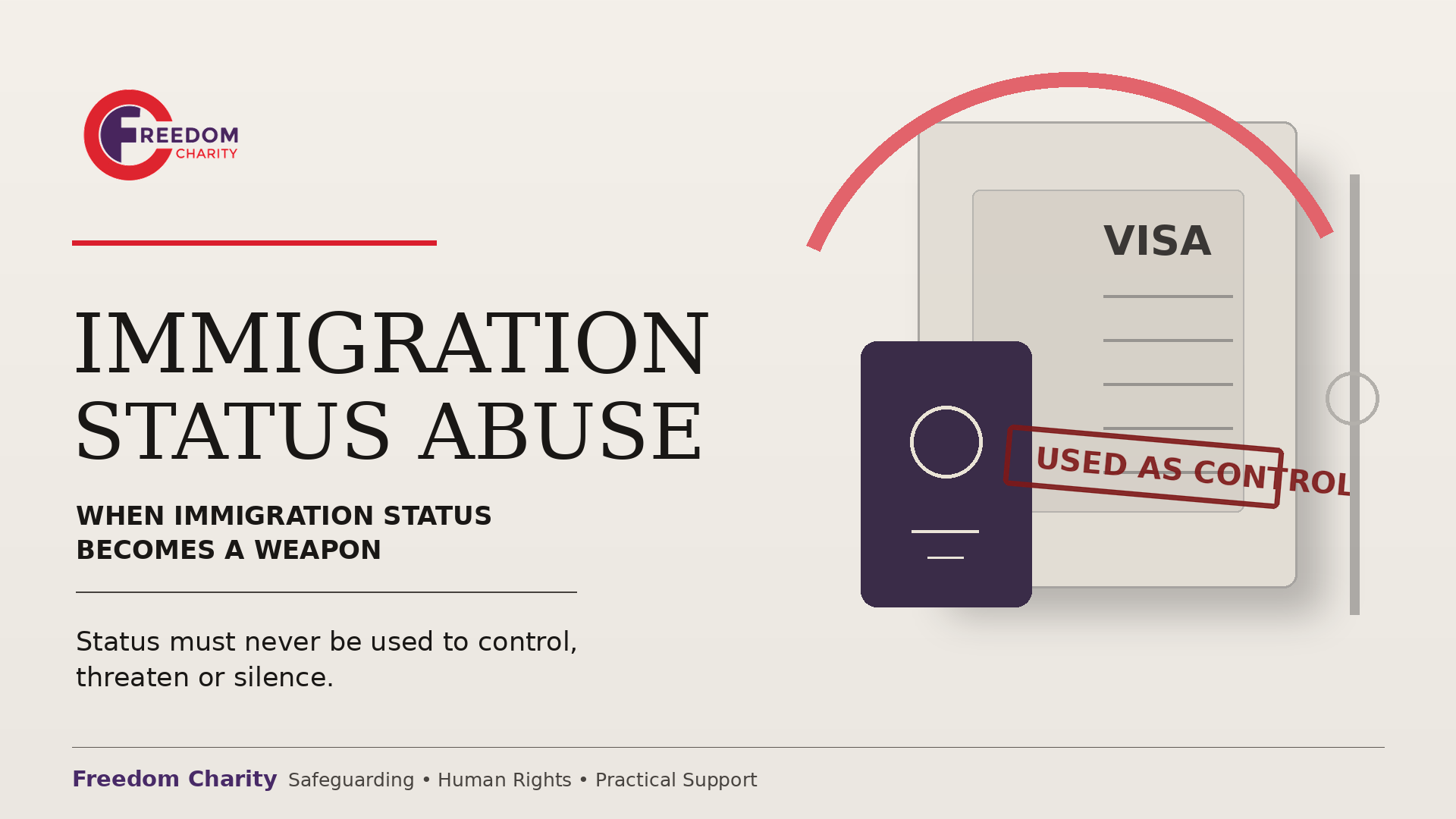
Immigration Status Abuse: When Immigration Status Becomes a Weapon
Immigration status abuse happens when someone uses a person’s visa, documents, dependency, language barriers or fear of deportation to control them. It can form part of domestic abuse, coercive control, forced marriage, trafficking, financial abuse and dishonour abuse. This is not an immigration debate. It is a safeguarding issue. No person should feel trapped in harm because an abuser has turned their status into a threat.
What is immigration status abuse?
Immigration status abuse is a form of control.
It can happen when a partner, spouse, parent, relative, in-law or wider family network uses a person’s immigration position to frighten, silence or isolate them.
Sometimes the abuse is direct. A perpetrator may say, “If you leave, I will report you.” They may hide a passport, take a biometric document, destroy letters, control money, stop someone from learning English or block access to legal advice.
However, the threat can also sound quieter. A survivor may hear that no one will believe them, that police will arrest them, that social workers will take their children, or that their family will suffer shame if they speak.
In practice, the purpose is always the same: control.
Why this is a safeguarding issue
Public debate about immigration can become angry, careless and political. Safeguarding must be different.
A person can have a complex immigration position and still be a victim of abuse. Both facts can exist at the same time. Therefore, professionals must not allow politics, fear or assumptions to obscure risk.
The better question is not: “Why did they stay?”
The better question is: “What was used to stop them leaving?”
For some survivors, fear does the work. For others, control may involve children, money, housing, documents, family pressure, language barriers, threats or isolation. Often, several forms of abuse operate together.
Because immigration status abuse can silence disclosure, professionals need to recognise it early.
How perpetrators use immigration status as a weapon
Perpetrators may use immigration status abuse to:
- threaten deportation;
- hide or destroy passports and documents;
- control Home Office letters, emails or online accounts;
- refuse to support a visa application;
- give false information about a person’s rights;
- stop someone seeking legal advice;
- prevent work, education or English classes;
- tell someone that police or social services will punish them;
- pressure someone to marry, stay married or sponsor another person;
- abandon a spouse overseas;
- use dishonour, shame or family reputation to stop disclosure.
These behaviours are not minor family disagreements. Instead, they may show a deliberate pattern of coercion.
The Crown Prosecution Service updated its guidance in 2026 to include immigration-related exploitation within its work on so-called “honour”-based abuse, forced marriage and harmful practices. Freedom Charity uses the term dishonour abuse because there is no honour in control, violence, forced marriage or intimidation.
The link with forced marriage
Immigration status abuse can sit closely beside forced marriage.
Forced marriage is illegal in the UK. GOV.UK describes forced marriage as a marriage where one or both people do not, or cannot, consent and pressure or abuse is used. It also states that anything done to make someone marry before they turn 18 is forced marriage, even if pressure or abuse is not used.
In some cases, immigration status becomes part of the pressure. A person may face pressure to marry to protect family reputation, sponsor someone, preserve a household arrangement, secure status or avoid shame.
That is not consent. It is coercion.
Children and young people may face particular danger because adults often control travel, money, phones, passports, school attendance and family contact. As a result, schools, colleges, health professionals and social workers must treat sudden travel plans, unexplained absences, fear around family discussions or talk of marriage with care.
When documents become control
A passport is not just paperwork when someone is being controlled.
It may decide whether a person can prove identity, access help, seek advice, return to the UK, protect a child or leave an unsafe home. For that reason, professionals should never dismiss missing documents as a private family matter without asking safe questions.
The same concern applies to biometric residence permits, bank cards, phones, passwords, school records, National Insurance documents and Home Office correspondence.
Once a perpetrator controls access, isolation becomes easier.
Transnational marriage abandonment
Immigration status abuse can also cross borders.
Some survivors are taken abroad, abandoned, stripped of documents or blocked from returning to the UK. In those cases, risk may involve domestic abuse, forced marriage, coercive control, immigration abuse and serious safeguarding harm.
The Forced Marriage Unit can provide advice where forced marriage is suspected. In an emergency, call 999.
Professionals should act before travel where possible. Once someone has left the UK, risk can rise quickly, especially if family members control documents, phones, money or movement.
Why fear stops people asking for help
Abusers understand fear.
They may know that a survivor fears police, immigration enforcement, homelessness, poverty, family retaliation or losing children. Therefore, they use that fear with precision.
A safeguarding system that frightens people away from help will miss abuse. It may only see the risk when the harm has escalated.
Professionals do not need to give immigration advice. In fact, they should not give casual legal advice at all. However, every professional can recognise risk, record concerns, consider safeguarding duties and refer the person to regulated immigration advice or specialist support.
That distinction matters. Good safeguarding does not require guesswork. It requires careful listening, accurate recording and proper referral.
What support may exist?
Some migrant victims of domestic abuse may be able to apply for the Migrant Victims of Domestic Abuse Concession. GOV.UK explains that this concession can provide temporary permission to stay and access to public funds for certain eligible victims.
Some people may also be able to apply for a settlement where a relationship has broken down because of domestic violence or abuse. GOV.UK explains that domestic violence and abuse can include emotional, psychological, physical, sexual or financial abuse, as well as threatening or controlling behaviour.
However, immigration law is complex. Eligibility depends on the facts. Therefore, survivors need advice from a solicitor, accredited immigration adviser or a specialist service. A kind but inaccurate answer can increase risk.
Questions professionals should ask
Professionals should ask careful questions in private, without family members present. They should also use independent interpreters. Children must never interpret in safeguarding conversations.
Useful questions include:
- Does anyone else hold your passport or documents?
- Has anyone threatened to report you to immigration authorities?
- Has anyone told you that you have no rights?
- Are you being stopped from working, studying or learning English?
- Are you afraid to speak to the police, school, health services or social services?
- Has anyone pressured you to marry, stay married or sponsor someone?
- Are children being used as part of the threat?
- Has anyone taken you abroad or threatened to leave you abroad?
- Do you have safe access to your phone, email and Home Office account?
These questions can reveal control that may otherwise stay hidden.
What schools should notice
Schools often see early warning signs before anyone else.
A pupil may mention a family trip, engagement, marriage or pressure at home. Another child may disclose concern about a friend. Attendance may change. Behaviour may shift. A young person may become withdrawn, anxious or frightened after family conversations.
Because forced marriage and dishonour abuse can escalate during school holidays, staff should take concerns seriously before travel takes place.
Freedom Charity works with schools through safeguarding education, books, awareness work and practical resources. Our Freedom Charity phone app also provides information and signposting for people at risk, friends and professionals.
Prevention must reach children before a crisis.
Why boys and young men matter
Safeguarding education must not speak only to girls.
Freedom Charity’s Not in My Name campaign speaks to boys and young men because they also need to understand consent, coercion, family pressure, forced marriage and FGM.
When boys and young men reject abuse, silence weakens. When they understand that forced marriage and dishonour abuse harm whole families and communities, prevention becomes stronger.
What families and communities must understand
No family reputation is worth a person’s safety.
No immigration status gives someone the right to threaten, control or silence another person.
No spouse, parent, relative or community figure should hide documents, threaten deportation, force marriage, isolate a child or use shame as a weapon.
Dishonour abuse thrives when people look away. It also thrives when professionals become nervous about naming abuse because it involves family, culture, faith or immigration.
The answer is not prejudice. The answer is precision.
Name the abuse. Protect the person. Use the law. Refer properly. Act early.
Freedom Charity’s position
Freedom Charity was founded to support people facing forced marriage, FGM and dishonour abuse. Our work focuses on prevention, education, safeguarding and early intervention.
Abuse rarely appears in one neat category. A child at risk of forced marriage may also face surveillance, emotional abuse, threats, travel risk and isolation. A survivor of domestic abuse may also face immigration threats, financial control and family pressure. Someone trapped by dishonour abuse may believe silence is the price of survival.
It is not.
Immigration status abuse must be recognised for what it is: a weapon of control.
When professionals understand it, survivors become safer. When schools teach children about consent and choice, children gain protection earlier. When communities reject shame and silence, perpetrators lose power.
How Freedom Charity helps
Freedom Charity provides education, prevention work and practical safeguarding routes for children, families, schools and professionals.
You can learn more through:
- Forced Marriage
- Dishonour Abuse
- Freedom Charity’s phone app
- Helpline information
- But It’s Not Fair
- School and professional training
- Not in My Name campaign
Freedom Charity reports that it has donated more than 100,000 copies of But It’s Not Fair and Cut Flowers to children, schools, professionals and libraries. Those books help children and adults recognise forced marriage, FGM and safeguarding risk earlier.
Support Freedom Charity
If this article helps you understand immigration status abuse, please help Freedom Charity reach more children, schools and families.
You can donate to Freedom Charity, invite us to speak in a school, share our safeguarding resources, support our campaigns or help fund practical work with children and survivors at risk.
This work is not political. It is child protection.
Where to get help
If someone is in immediate danger, call 999.
If you are worried about forced marriage, contact the Forced Marriage Unit on 020 7008 0151.
If you are a child, or worried about a child, contact the NSPCC on 0808 800 5000 or Childline on 0800 1111.
You can also visit Freedom Charity’s helpline page for support routes and emergency information.
Immigration status must never become a weapon.
A country can have immigration laws and still protect people from abuse. A professional can recognise legal complexity and still identify coercive control. A survivor can feel frightened, dependent and uncertain, yet still deserve safety.
Safeguarding begins with one clear principle: protect the person in danger.
FAQs
What is immigration status abuse?
Immigration status abuse happens when someone uses a person’s visa, documents, dependency, language barriers or fear of deportation to control, threaten or trap them.
Is immigration status abuse a safeguarding issue?
Yes. Immigration status abuse can stop someone leaving harm, contacting police, attending school, accessing healthcare or seeking legal advice.
Can immigration status abuse happen in forced marriage cases?
Yes. Immigration status may be used to pressure someone into marriage, keep them in a marriage, force sponsorship or silence disclosure.
What should someone do if their passport is being controlled?
They should seek safe help from a trusted professional, safeguarding lead, specialist domestic abuse service, solicitor or accredited immigration adviser. If there is immediate danger, call 999.
How can people support Freedom Charity?
People can donate, share safeguarding resources, invite Freedom Charity into schools, support campaigns, buy Freedom Charity books and help more children understand their rights.
DONATE to Freedom Charity
Aneeta Prem MBE, Founder of Freedom Charity. London. 20 May 2026