



Why these figures need caution
Every year, the UK publishes a number on forced marriage.
When it rises, people worry. When it falls, some assume progress.
However, that is the mistake.
Forced marriage does not reveal itself neatly in an annual return. Fear, family pressure, controlled phones, school absences, sudden travel plans and children who do not come back after the holidays can all hide it.
Some victims reach the Forced Marriage Unit.
Many never will.
For that reason, the Forced Marriage Unit statistics matter. They show who has become visible to the system.
At the same time, the figures expose the limits of any official dataset on a hidden crime.
In plain terms, these statistics measure recorded contact and casework. They do not measure the true scale of forced marriage.
At Freedom Charity, we treat forced marriage as safeguarding, not culture.
No one should dismiss it as a private family matter. Nor should anyone call it tradition when a person is threatened, pressured, deceived, trapped or made to marry before they are old enough to choose.
Forced marriage is abuse.
What the 2025 Forced Marriage Unit statistics show
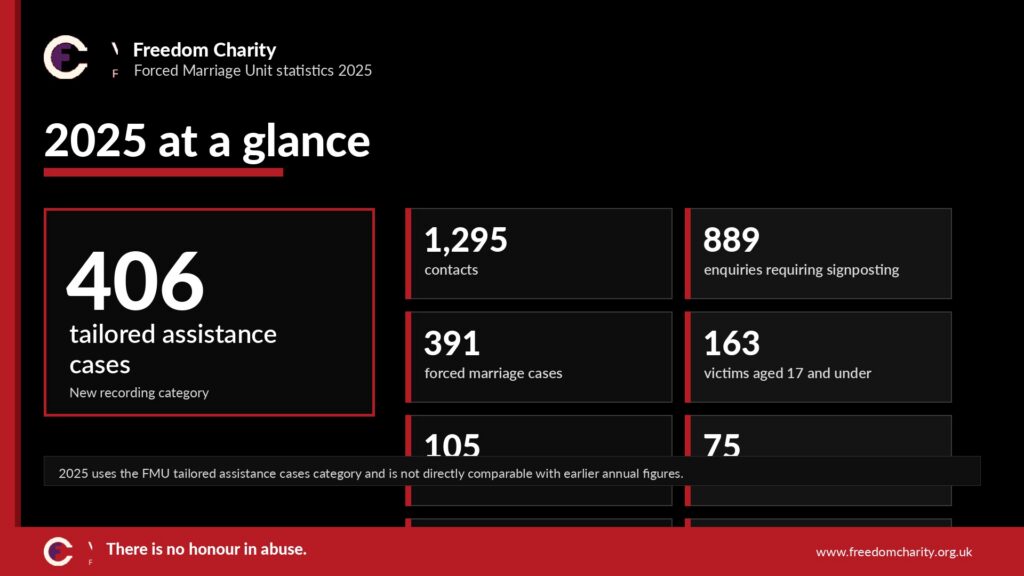
In 2025, the FMU recorded 1,295 contacts.
Those contacts included 406 tailored assistance cases and 889 enquiries requiring signposting.
Within the tailored assistance cases, 391 related to forced marriage. Another 15 involved FGM overseas.
Key figures from 2025 include:
Contacts: 1,295 contacts reached the FMU.
Tailored assistance: 406 cases received tailored assistance.
Signposting: 889 enquiries required signposting.
Forced marriage: 391 tailored assistance cases related to forced marriage.
FGM overseas: 15 tailored assistance cases involved FGM overseas.
Children: 163 cases involved victims aged 17 and under.
Women and girls: 301 cases involved female victims.
Men and boys: 105 cases involved male victims.
Mental capacity: 75 cases involved mental capacity concerns.
LGBT+ risk: 5 cases recorded LGBT+ identity as a driving factor.
UK-only cases: 58 cases had no overseas element.
Education referrals: 25 referrals came from education professionals.
However, the FMU changed the category in 2025 to “tailored assistance cases”. Readers should not compare it directly with earlier annual casework figures.
That distinction matters. For example, careless reading can create false confidence or false alarm.
Therefore, the 2025 figures should be read as evidence of visibility, not as proof of the true scale of forced marriage.
As a result, these numbers show who reached help, who professionals referred, who disclosed, and who the FMU recorded.
Behind every figure sits another question: who did not appear?
The long view: recorded cases from 2011 to 2024
The 2024 FMU statistics provide the long-running annual table.
From 2011 to 2019, the FMU recorded more than 1,000 cases every year. In 2018, the figure reached 1,507.
By 2024, the recorded total had fallen to 240.
2011: 1,468 cases
2012: 1,485 cases
2013: 1,302 cases
2014: 1,267 cases
2015: 1,220 cases
2016: 1,428 cases
2017: 1,196 cases
2018: 1,507 cases
2019: 1,355 cases
2020: 759 cases
2021: 337 cases
2022: 302 cases
2023: 283 cases
2024: 240 cases
At first glance, the figures may suggest a simple decline.
However, that would be unsafe.
The 2020 FMU statistics linked the fall that year largely to the coronavirus pandemic, including restrictions on weddings and overseas travel. A recording change also had some effect.
In addition, the 2021 FMU statistics explained that changes in how the FMU logged contacts had a notable impact on case numbers.
As a result, the FMU recorded some contacts as general enquiries, although earlier years may have treated similar contacts as forced marriage referrals.
Therefore, the lesson is not that forced marriage disappeared.
Instead, the figures show how hidden abuse can be affected by disruption, recording rules, professional confidence and victim visibility.
In safeguarding, the question is never only: how many cases did the system record?
Another question matters just as much: who did not reach help?
Why the data cannot be treated as prevalence
The Forced Marriage Unit is a joint Home Office and Foreign, Commonwealth and Development Office unit. It works on forced marriage policy, outreach and casework.
Its annual statistics cover cases reported through the public helpline and email inbox. They do not count every forced marriage in the UK.
The 2025 release says the figures only represent cases reported to the FMU where the Unit actively gave tailored assistance. It also says forced marriage is often hidden in nature and that the figures do not reflect the full scale of the abuse.
For that reason, the warning should shape every headline written about the data.
A rise in recorded cases may mean more abuse. However, better reporting, greater awareness or stronger professional confidence may also explain the increase.
By contrast, a fall may mean less abuse. It may also mean fewer disclosures, weaker referral routes or victims being unable to reach help.
In hidden abuse, lower figures are not always good news.
The law has changed, but risk has not disappeared
The UK’s legal response to forced marriage has strengthened over time.
Forced Marriage Protection Orders came into force from 2008.
Scotland introduced forced marriage protection legislation in 2011 under the Forced Marriage etc. (Protection and Jurisdiction) (Scotland) Act 2011.
Forced marriage became a criminal offence in England, Wales and Scotland in 2014. Separate provisions apply in Northern Ireland.
GOV.UK’s forced marriage guidance describes forced marriage as domestic abuse and a serious abuse of human rights.
In England and Wales, the minimum age for marriage and civil partnership rose to 18 on 27 February 2023.
The GOV.UK announcement confirms that 16 and 17-year-olds can no longer marry or enter a civil partnership, even with parental consent.
GOV.UK guidance also states that forced marriage includes doing anything to make someone marry before they turn 18, even if pressure or abuse is not used.
In addition, Forced Marriage Protection Orders remain a vital civil protection route. They can protect someone at risk of forced marriage or someone already in a forced marriage.
Freedom Charity also has a practical Forced Marriage Protection Order guide for professionals and families.
Although the law has moved, risk has not disappeared.
Children are still appearing in the figures
For schools, the child figures should be deeply troubling.
In 2025, 163 tailored assistance cases involved victims aged 17 and under. That was 40% of the 406 tailored assistance cases.
Of these, 87 involved children aged 15 and under. A further 76 involved victims aged 16 to 17.
Therefore, forced marriage is not only a marriage issue.
It is child protection.
The 2025 release explains that cases involving young children may relate to a promised future marriage, a younger sibling at risk or cases linked to FGM overseas.
As a result, warning signs can appear long before a wedding date exists.
A child may mention a future ceremony. A sibling may disclose risk. Family members may discuss travel. Fear may appear before the holidays.
When a child is afraid of a trip abroad, professionals must act before the flight is booked.
Education referrals are too low
The 2025 referral figures raise a serious question.
Social services made 112 referrals. Police made 52. Victims themselves made 58.
By contrast, education professionals made 25.
However, that does not prove schools are failing. A case may reach the FMU through social care, police, health, the Home Office, family, friends or charities after a school has already acted.
Even so, the pattern deserves attention.
In practice, schools are often the only universal service seeing children every day.
Teachers may notice withdrawal, fear, talk of travel, a sudden engagement, pressure to obey or a child who does not return after the holidays.
If children are central to the data but education referrals remain low, the issue is not blame.
Instead, the issue is whether schools have the training, confidence and referral routes to act early.
Freedom Charity supports prevention through education, safeguarding resources and work with young people.
Our page on forced marriage and FGM books for schools explains why stories can help children understand risk, pressure and safe routes to help before crisis.
For schools: warning signs before travel
Before travel, possible warning signs may include:
sudden or extended family travel plans
fear about travelling abroad
talk of a wedding, engagement or ceremony
comments that a child may not return to the UK
passports or documents being taken
older siblings disappearing from education
withdrawal, anxiety or distress
family members refusing to give clear travel details
pressure linked to shame, obedience or family reputation
instructions not to speak to professionals
Schools should not investigate alone.
Instead, staff should follow safeguarding procedures, seek specialist advice and act before travel takes place where risk is identified.
Men and boys are in the data
Forced marriage disproportionately affects women and girls. The FMU states this clearly.
However, male victims are not rare exceptions.
In 2025, 105 of the 406 tailored assistance cases involved male victims. That is 26%.
A year earlier, 69 of the 240 advice and support cases involved male victims. That is 29%.
Women and girls remain the majority of identified victims. Even so, men and boys are still too often left out of the conversation.
Male victims may face pressure linked to disability, sexuality, family reputation, inheritance, immigration control or obedience.
Some may face marriage pressure to conceal or deny their sexuality. Others may be placed in marriages they cannot understand, refuse or escape.
Therefore, a safeguarding system that expects victims to look a certain way will miss people in plain sight.
Freedom Charity’s Dishonour Abuse work makes clear that abuse carried out in the name of so-called honour centres coercion and control, not honour.
Mental capacity is one of the most serious issues
In 2025, 75 tailored assistance cases involved victims whose mental capacity to consent to marriage was in doubt. That was 18% of the 406 cases.
The 2025 release says victims with mental capacity concerns were more likely to be male and older than victims in the dataset overall.
In 2024, the FMU recorded 63 cases involving mental capacity concerns.
Consent is the foundation of marriage.
Where a person cannot understand, retain, use or weigh information, or cannot communicate a decision, questions of capacity become central.
This is also about adult safeguarding, disability rights and family control.
Some people depend on relatives for care, housing, money or communication. That dependency can make abuse easier to hide and harder to disclose.
The question is blunt: who is protecting adults who may not be able to refuse marriage, understand it or escape it?
LGBT+ victims may be hidden inside low numbers
The 2025 release recorded five cases where the victim voluntarily identified as LGBT+ and where this was a driving factor in the forced marriage.
The same release warns that the true number is expected to be higher because the FMU does not collect that information from all victims.
It also identifies forced marriage as a possible form of so-called conversion practice, where families use marriage as a supposed “cure” for a person being LGBT+.
Although the recorded number is small, its safeguarding meaning is not.
A gay man may not tell a professional that sexuality is part of the pressure.
Fear of violence, rejection or confinement may silence a lesbian or bisexual woman.
For trans people, a safe and private space to speak may never be offered.
If telling the truth could put someone in greater danger, low numbers should never comfort us.
Forced marriage does not always require travel
Forced marriage is still strongly associated with overseas travel. That risk remains real.
In 2025, 67 pre-marriage cases involved victims who were overseas at the point of referral.
A further 18 post-marriage cases involved victims overseas.
The FMU also supported or advised on 22 repatriations.
Professionals should remain alert to sudden travel, extended holidays, missing passports, children not returning to school and families refusing to give clear travel details.
Yet forced marriage does not always require a passport.
In 2025, 58 cases had no overseas element. The potential or actual forced marriage was linked entirely to the UK.
Of those cases, 20 involved victims aged 17 and under.
A victim does not have to leave the country to lose control of their life.
The issue is not where the marriage is planned.
It is whether the person can freely say no.
Country data must never become stereotyping
The FMU records “focus countries”. This means the country to which the risk of forced marriage relates.
In 2025, the FMU handled cases linked to 34 focus countries, excluding the UK.
Pakistan accounted for 165 cases. Bangladesh accounted for 36. Afghanistan accounted for 28.
Country data can help professionals understand patterns of risk.
However, used badly, it can also feed stereotyping.
The 2025 release states that forced marriage is not specific to one country, religion or culture.
It also says there is no archetypal victim or perpetrator.
Therefore, safeguarding must be evidence-led, not stereotype-led.
The right question is not: “What community is this family from?”
Professionals should ask: “What is happening to this person, and can they freely consent?”
Police data tells the same cautionary story
The Home Office also publishes police-recorded statistics on so-called honour-based abuse offences in England and Wales.
Freedom Charity uses the term Dishonour Abuse because there is no honour in abuse.
Again, police data is not the same as FMU data.
For example, police figures record offences identified and flagged by police forces.
By contrast, FMU figures record contacts and casework reaching the Forced Marriage Unit.
Therefore, they are different windows into hidden abuse, not two versions of the same count.
In the year ending March 2025, the Home Office recorded 2,949 so-called honour-based abuse related offences in England and Wales.
That included 125 forced marriage offences and 109 FGM offences.
The Home Office warns that police-recorded data for this hidden form of abuse is likely to represent only a fraction of actual offences.
It should not be treated as prevalence data.
Therefore, that warning should be taken seriously.
Across hidden abuse datasets, visibility is not the same as prevalence.
What the data cannot count
Official figures cannot tell us how many victims never disclosed.
No dataset can show every child taken abroad without referral.
Nor can an annual return count every school concern that never escalated.
In addition, records will miss victims prevented from contacting services.
Many LGBT+ victims may hide the reason for family pressure.
Disabled or autistic victims may never reach a safeguarding professional.
Some forced marriages may stop before FMU involvement.
Other cases may involve people trapped inside the UK under family control.
No annual return can fully show every form of control linked to immigration status, abandonment overseas, cousin marriage pressure or threats linked to family reputation.
Cases handled outside the FMU may also never appear.
These gaps are not failures of the Forced Marriage Unit.
Instead, they reveal the limits of administrative data.
Every dataset contains two populations: those who appear and those who do not.
In forced marriage, the second group may be the most important.
What should change now
Freedom Charity believes the data points to practical action.
Before key holiday periods, schools need stronger forced marriage training.
Safeguarding leads also need clearer routes for seeking specialist advice.
Professionals must understand that forced marriage can affect boys and men.
Adult safeguarding teams need greater awareness of mental capacity and forced marriage.
Services should recognise LGBT+ risk safely and sensitively, without forcing disclosure.
In addition, professional training must include UK-only forced marriage.
Government statistics should continue to make methodology changes clear.
Annual reporting should also distinguish more clearly between prevalence, visibility, enquiries and casework.
Meanwhile, public commentary should stop treating a fall in reported cases as automatic progress.
The test is not whether the figures look reassuring.
Instead, the test is whether victims can reach safety.
Freedom Charity provides training for professionals working with children, families and adults at risk.
Why Freedom Charity is saying this
Freedom Charity works to prevent forced marriage, FGM and Dishonour Abuse through education, safeguarding resources, direct support and public campaigning.
However, our concern is not only what the official figures show. It is also what they may fail to reveal.
People under the tightest control are often the least able to disclose. Those most isolated are also the least visible to services.
Therefore, early education, professional training and safe routes to help matter.
Freedom Charity’s book But It’s Not Fair helps young people understand forced marriage, pressure, fear and the right to choose.
The missing victims are the point
The Forced Marriage Unit statistics matter because they show who is coming forward and where risk becomes visible.
However, statistics are not safety.
The real test of the UK’s response to forced marriage is not whether next year’s figure is higher or lower.
Before a flight is booked, a child frightened of a summer trip must be believed.
When a boy is forced to hide his sexuality, professionals must recognise him as a victim.
Where an adult lacks capacity to consent, safeguarding teams must act before a marriage is arranged.
For young people trapped inside family homes, help must be reachable before the system has a number to record.
The missing victims are not a statistical problem.
They are the reason Freedom Charity exists.
Further reading and sources
Latest FMU release: Forced Marriage Unit statistics 2025
Annual casework table: Forced Marriage Unit statistics 2024
Pandemic-period context: Forced Marriage Unit statistics 2020
Recording changes: Forced Marriage Unit statistics 2021
Legal definition: GOV.UK forced marriage guidance
Professional practice: Multi-agency statutory guidance on forced marriage
Marriage age reform: Legal age of marriage in England and Wales rises to 18
Protection orders: Forced Marriage Protection Orders guidance
Police-recorded abuse data: Home Office data on so-called honour-based abuse offences, year ending March 2025
Scotland legislation: Forced Marriage etc. (Protection and Jurisdiction) (Scotland) Act 2011
Forced marriage and FGM books for schools
Dishonour Abuse
Forced Marriage Protection Order guide
Training for professionals
But It’s Not Fair
Aneeta Prem London 21 June 2026