



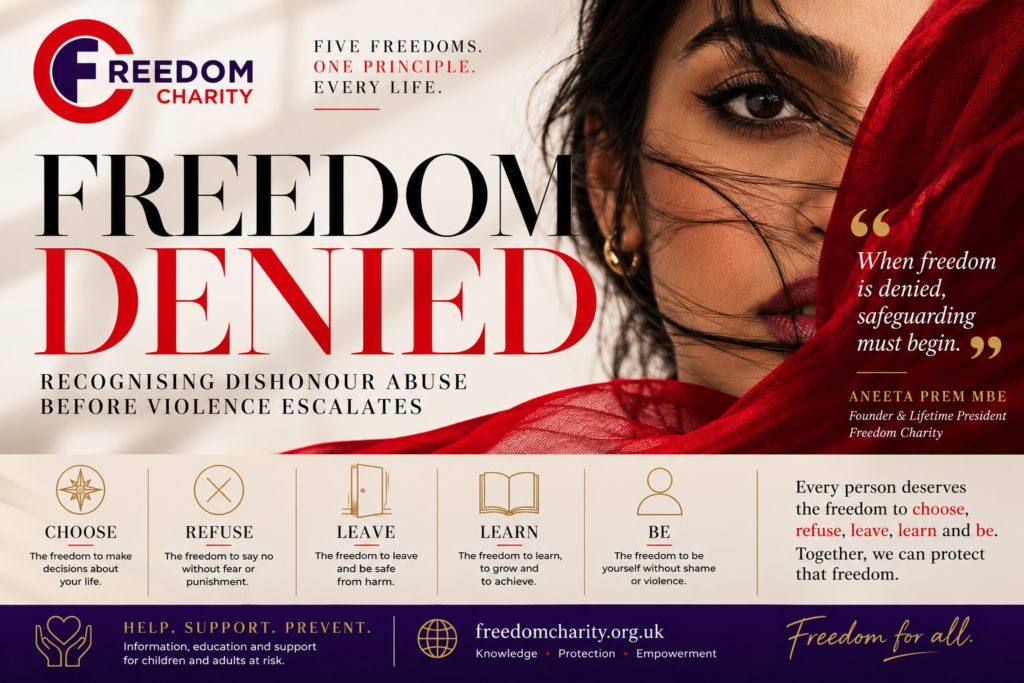
 Dishonour Abuse Freedom Denied Recognising Dishonour Abuse Before Violence Escalates
By Aneeta Prem MBE, Founder and President of Freedom Charity
These deaths were not about honour. They were about freedom being denied.
Dishonour Abuse Freedom Denied often begins before physical violence becomes visible. A young person may lose access to education, relationships, money, documents or independent movement while relatives present those restrictions as care, protection or family duty.
Through my work with Freedom Charity, I have seen how control can grow gradually. A passport disappears. Someone begins monitoring a telephone. University plans suddenly end. A relationship attracts threats, while a proposed trip abroad causes fear.
Individually, each warning may appear uncertain. Taken together, however, they can reveal that someone’s freedom is being systematically removed.
That is where safeguarding must begin.
What is dishonour abuse?
Dishonour abuse is violence, coercion or control used against someone whose actual or perceived conduct is believed to have damaged the reputation, expectations or standing of a family, partner or wider network.
It may include forced marriage, threats, surveillance, confinement, financial control, digital monitoring, forced travel, removal of documents, restriction of education, punishment for relationships or identity, physical or sexual violence, and murder.
Freedom Charity uses the term dishonour abuse because abuse carries no honour. Government bodies, police and prosecutors commonly use the established expressions “honour”-based abuse or so-called honour-based abuse. We recognise those official terms when referring to legislation, policy or professional guidance, but our own language places responsibility where it belongs: with those who threaten, control or harm another person.
This abuse is not defined by ethnicity, nationality, faith or culture. Instead, professionals should identify it through conduct, power and the denial of personal autonomy.
Why language matters
Language directs attention.
When public discussion begins with a perpetrator’s claim of honour, it can become preoccupied with reputation, tradition or family standing. As a result, the person at risk may disappear behind the explanation offered by those controlling them.
A safer starting point is the life being restricted.
Who controls the person’s movement, money or documents? Is someone monitoring their telephone? Who decides whether they can continue their education? Does anyone know that they have asked for help? What do they believe will happen if they refuse, leave or seek protection?
These are safeguarding questions, but they are also questions of fundamental human rights.
The Five Freedoms
I use five simple freedoms — to choose, refuse, leave, learn and be — as a practical way to organise safeguarding questions about autonomy and control. They are reflective prompts, not a statutory framework, validated risk-assessment tool or substitute for specialist safeguarding practice.
The freedom to choose
The first question is whether the person can make decisions about relationships, marriage, education, work, belief and their future without fear of punishment.
The freedom to refuse
Equally important is the ability to say no to marriage, sex, travel, family demands or unwanted contact without facing threats, violence or abandonment.
The freedom to leave
Where abuse is present, the person must be able to leave a relationship, household or controlling network without being followed, located or deprived of support.
The freedom to learn
Education also matters. A child or adult should be able to attend school, college or university, access information and develop an independent future.
The freedom to be
Ultimately, everyone should be able to live without punishment for their identity, sexuality, beliefs, disability, voice or self-expression.
These prompts do not replace legislation, statutory safeguarding duties, professional judgement or specialist risk assessment. Their purpose is to keep attention on whether a person can exercise basic choices freely and safely.
When control is mistaken for care
Control rarely announces itself honestly.
A relative may say, “We only want what is best for you,” while confiscating a passport, monitoring friendships or threatening punishment. Similarly, a partner may describe surveillance as concern, while a family presents forced marriage as duty or protection.
Professionals must assess conduct and impact, not simply the explanation offered by those imposing the restriction.
A person may also struggle to describe the danger clearly. Fear, dependency and divided loyalties may cause them to withdraw a disclosure, return home, minimise threats or appear uncertain.
They may need documents, money, medication, housing or contact with siblings and children. None of these circumstances automatically means that the original risk has passed.
Remembering lives with dignity
The people considered in Freedom Denied lived in different countries, communities, families and legal systems. Their experiences are not interchangeable and must never be reduced to a single cultural narrative.
No article, chapter or case summary can contain the fullness of a human life or the grief carried by those left behind. For that reason, this work draws carefully on responsibly sourced public material.
It does not claim to speak for victims or bereaved families, nor does it invent private detail to create emotional effect.
Its purpose is to examine what professionals, institutions and society can learn while keeping dignity, accuracy and prevention at the centre.
What professionals should do
Where relatives or a wider network may form part of the danger, professionals should not contact the family, arrange mediation or reveal the person’s location before specialist assessment.
A well-intentioned telephone call can expose a disclosure and increase risk.
The first response should be private, calm and practical. Professionals should establish whether the person is safe to return home and identify who knows about the disclosure.
They should also ask whether travel is planned, who controls the person’s telephone, money or documents, and which relatives or other people may be involved.
In addition, professionals need to agree how future contact can take place safely and understand what the person believes may happen if they refuse or leave.
The person’s own words should be recorded carefully, while specialist safeguarding advice should be sought without unnecessary delay.
A central safeguarding question
One useful question is:
Can this person live freely and safely?
A negative answer does not automatically prove that a criminal offence has occurred. It does, however, indicate that autonomy may be under threat and that further safeguarding enquiry is necessary.
The next questions concern who is imposing the restriction, how they enforce it, what may happen if the person resists and what protection they need now.
Safeguarding should not wait until violence becomes undeniable. It must begin when someone’s world starts to narrow through fear, coercion and control.
From recognition to prevention
Freedom Charity works to protect children and adults from forced marriage and related forms of abuse through education, professional training, public awareness and direct support.
Freedom Denied develops that work by placing freedom at the centre of recognition.
Every person should have the freedom to choose, refuse, leave, learn and be. However, those freedoms become meaningless when threats, coercion or violence make them impossible to exercise.
For that reason, professionals must look beyond the explanation offered by those imposing control. Instead, they should focus on the person whose choices, safety and future are being restricted.
The language of honour centres the perpetrator’s claimed grievance, whereas the language of freedom centres the person who needs protection.
That is where safeguarding must begin.
Frequently asked questions
Who is Aneeta Prem MBE?
Aneeta Prem MBE is Founder and President of Freedom Charity. She is the author of But It’s Not Fair and Cut Flowers and has worked on forced marriage, FGM, Dishonour Abuse, safeguarding education and prevention.
What is dishonour abuse?
Dishonour abuse is violence, coercion or control used against someone whose conduct is believed to have damaged the reputation or expectations of a family, partner or wider network.
What are the Five Freedoms?
In this article, Aneeta Prem uses five freedoms — to choose, refuse, leave, learn and be — as practical prompts for thinking about autonomy and control. They are not presented as a statutory or validated safeguarding framework.
Is dishonour abuse the same as honour-based abuse?
The expressions refer to the same broad safeguarding field. Freedom Charity uses dishonour abuse because abuse carries no honour, while official organisations often use “honour”-based abuse or so-called honour-based abuse.
What should a professional do after a disclosure?
Speak to the person privately and assess whether they face immediate danger. Do not contact relatives, arrange mediation or reveal the person’s location before specialist risk assessment where family members may form part of the threat.
Are the Five Freedoms a legal test?
No. They are reflective prompts used in this article. They do not replace legislation, statutory guidance, professional judgement, validated risk tools or specialist safeguarding assessment.
Find help and further information
Visit Freedom Charity for information about forced marriage, dishonour abuse, safeguarding and support.
In an emergency, call 999.
Further information
Learn more about Freedom Charity’s work to prevent forced marriage and dishonour abuse.
Aneeta Prem MBE London 14 July 2026