



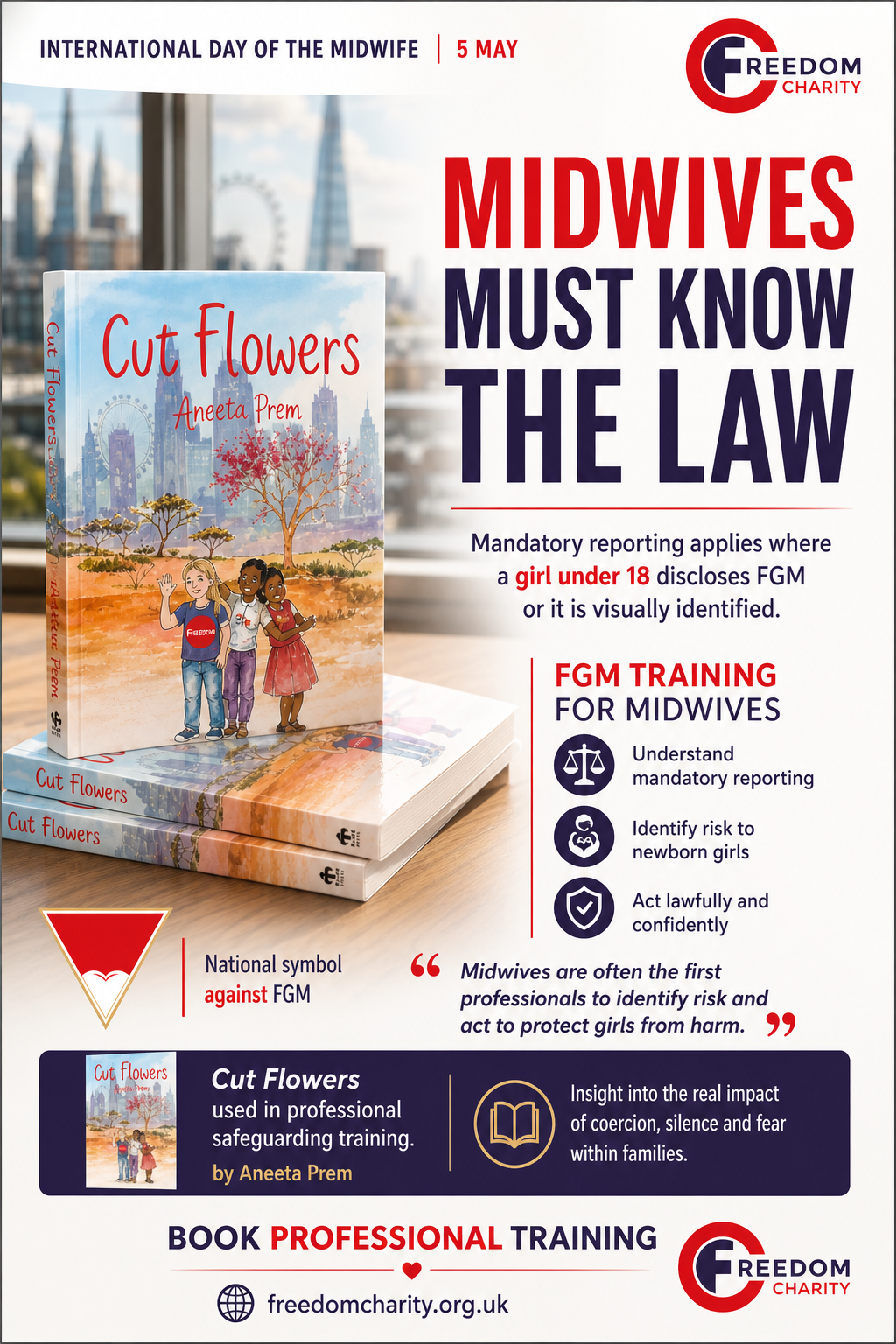
FGM Training for Midwives: What the Law Requires and Why Safeguarding Training Matters
On 5 May, International Day of the Midwife, we recognise the vital role midwives play in protecting women, babies and families. However, that recognition must include one difficult but essential safeguarding issue: female genital mutilation.
FGM training for midwives should not sit at the edge of professional learning. Instead, it should form part of clear safeguarding practice. In England and Wales, regulated professionals, including midwives, must report known cases of FGM in girls under 18 to the police when they identify the case during their professional work. This duty came into force on 31 October 2015.
Freedom Charity provides professional safeguarding training on FGM, forced marriage and dishonour-based abuse. To discuss training for your organisation, visit Freedom Charity or contact Freedom Charity.
Why FGM training for midwives matters
Midwives often sit at the first point of professional contact. They may meet a woman during pregnancy, birth or postnatal care. They may also be the first professional to recognise that a newborn girl has a family history of FGM and may need safeguarding attention.
Because of that frontline role, midwives need clear legal knowledge and practical safeguarding confidence. A missed concern can leave a child at risk. Also, a poorly handled conversation can silence a survivor. Therefore, professionals need training that explains both the law and the human reality.
The World Health Organization recognises International Day of the Midwife as a day to celebrate midwives and the importance of education, training, regulation and licensing in improving quality of care. FGM safeguarding belongs within that professional standard.
What does the law say about FGM?
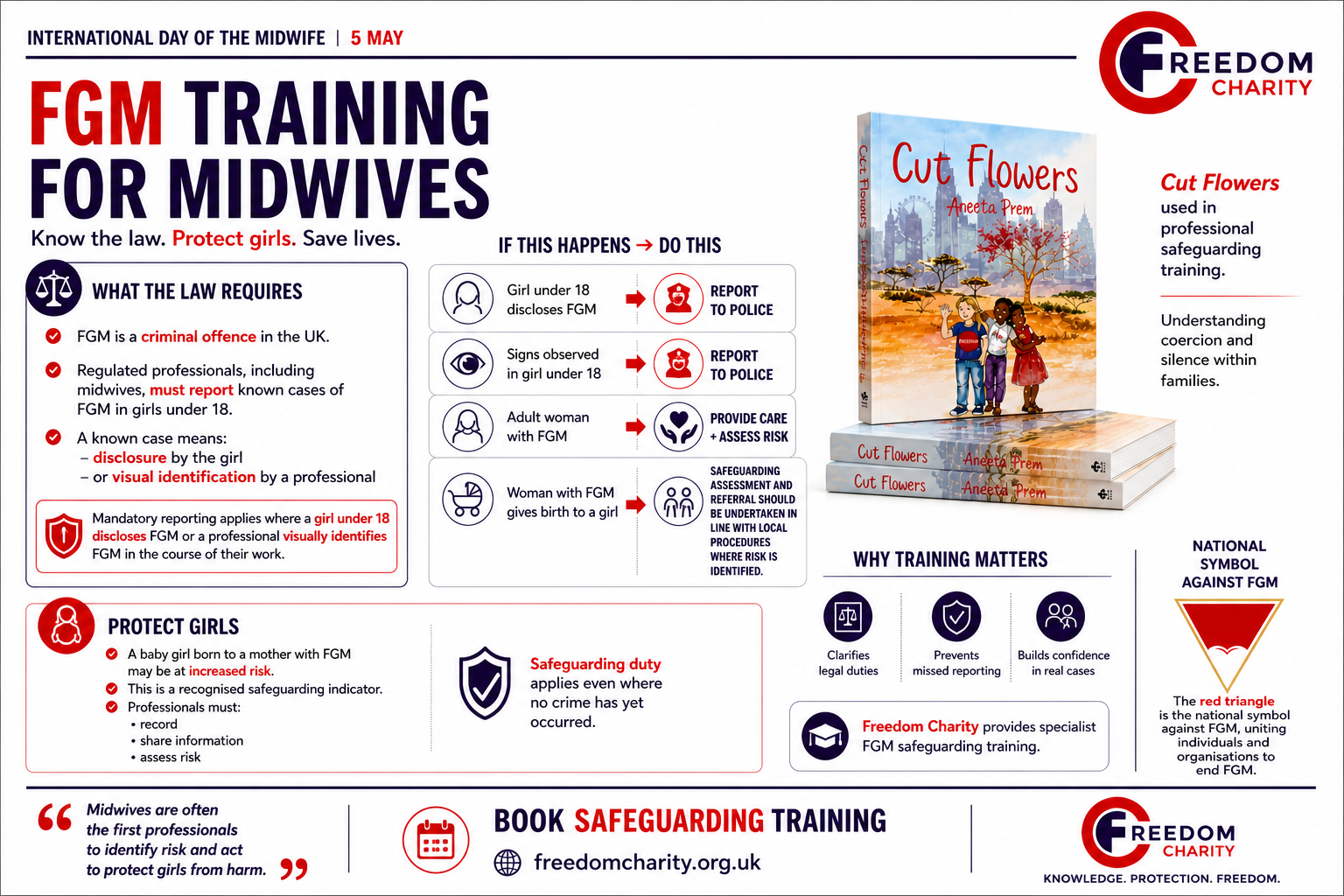
FGM is a criminal offence under the Female Genital Mutilation Act 2003. Section 5B of the Act introduced the mandatory reporting duty for regulated health and social care professionals and teachers in England and Wales.
For midwives, the duty applies where, during professional work:
- a girl under 18 discloses that FGM has been carried out on her; or
- a professional visually identifies FGM in a girl under 18.
Government guidance states that known cases must be reported to the police. However, the duty applies to known cases, not general suspicion alone.
For further professional context, Freedom Charity also provides FGM and safeguarding resources and wider professional resources.
The legal distinction every midwife must know
Professional confusion often arises at this point. Therefore, this distinction matters.
| Situation | Professional response |
|---|---|
| Girl under 18 discloses FGM | Report to police |
| FGM is visually identified in a girl under 18 | Report to police |
| Adult woman has FGM | Provide care and assess safeguarding risk |
| Woman with FGM gives birth to a girl | Consider safeguarding assessment and referral in line with local procedures where risk is identified |
The mandatory reporting duty applies to known cases involving girls under 18. However, adult women still need sensitive care, and professionals must consider safeguarding risk to any child.
If a woman with FGM gives birth to a girl, is the baby at risk?
A baby girl born to a mother with FGM may face increased safeguarding risk. Therefore, professionals should record concerns, share information appropriately and follow local procedures.
The NHS FGM Information Sharing system supports early intervention and ongoing safeguarding for girls under 18 who have a family history of FGM. NHS Digital explains that authorised healthcare professionals can view relevant information about girls with a family history of FGM across care settings.
Midwives and maternity teams should therefore:
- record information accurately;
- share information through appropriate safeguarding routes;
- assess risk;
- follow local child protection procedures;
- consider referral where risk is identified.
Safeguarding duties apply even where no crime has yet occurred.
 What should midwives do in practice?
Midwives do not need to investigate criminal offences. They do not need to prove who carried out FGM. However, they must know when the legal duty to report has been triggered and when wider safeguarding action is required.
In practice, midwives should:
- recognise the legal threshold for mandatory reporting;
- record concerns clearly and accurately;
- speak with care, dignity and without judgement;
- involve safeguarding leads where appropriate;
- act promptly where a girl may face risk;
- follow local safeguarding procedures.
This approach does not blame women who have already experienced FGM. Instead, it protects girls from harm and ensures survivors receive appropriate care.
Why training cannot be vague
General awareness helps, but it does not give professionals enough confidence when a real case appears in front of them. As a result, training must answer the questions midwives face in practice:
- Do I have to report this?
- Is this a known case or a safeguarding concern?
- What if the patient is an adult?
- What if she has just given birth to a girl?
- What should I write in the record?
- Who needs to know?
- How do I protect the child without alienating the mother?
For that reason, FGM training for midwives must be clear, lawful, practical and survivor-sensitive.
Freedom Charity training for professionals
Freedom Charity delivers safeguarding training for professional and frontline audiences. Its work covers forced marriage, FGM, Dishonour Abuse, child protection, safer responses and prevention education.
Freedom Charity training helps professionals understand:
- mandatory reporting duties;
- the difference between adult support and child safeguarding;
- risk indicators for girls;
- how to respond to disclosure;
- how to record and escalate concerns;
- how to act without blame, shame or cultural stereotyping.
This is the training professionals need when uncertainty could lead to harm.
Why Cut Flowers matters in safeguarding training
Cut Flowers by Aneeta Prem helps professionals understand how coercion, silence and fear can operate within families. That matters because safeguarding is not only about recognising visible harm. It is also about understanding why children may not disclose, why families may conceal risk, and why professionals must know what to do before a crisis becomes visible.
Used alongside legal training, Cut Flowers helps bridge the gap between policy and lived reality.
Book FGM safeguarding training
On International Day of the Midwife, celebration must include responsibility.
FGM is a criminal offence.
The legal duty to report known cases in girls under 18 is clear.
Girls with a family history of FGM must not be overlooked.
Book FGM safeguarding training with Freedom Charity and help ensure your staff act lawfully, confidently and safely.
Visit: www.freedomcharity.org.uk
Training enquiries: Contact Freedom Charity
FAQs
Do midwives have to report FGM?
Yes. In England and Wales, regulated professionals, including midwives, must report known cases of FGM in girls under 18 to the police when they identify the case during professional work.
Does mandatory reporting apply to adult women?
No. The mandatory reporting duty applies to known cases involving girls under 18. However, adult women with FGM should receive appropriate care and support. Professionals should also assess safeguarding risk to any children.
Is a baby girl at risk if her mother has FGM?
A baby girl born to a mother with FGM may face increased safeguarding risk. Therefore, professionals should record information, share it appropriately, assess safeguarding risk and follow local procedures. NHS FGM information-sharing systems support safeguarding for girls under 18 with a family history of FGM.
What should midwives do if FGM is visually identified in a girl under 18?
Where a regulated professional visually identifies FGM in a girl under 18 during professional work, the mandatory reporting duty applies. The professional must report the known case to the police.
Does Freedom Charity provide FGM training?
Yes. Freedom Charity provides specialist safeguarding training for professionals, including training on FGM, forced marriage and dishonour-based abuse. Visit Freedom Charity or contact the charity to discuss training.
Further reading:
Freedom Charity homepage
Book professional safeguarding training
FGM and safeguarding resources
Professional resources
Aneeta Prem MBE, Founder of Freedom Charity · 4 May 2026