



Would you call her parents? Freedom launches 16 Days campaign
Freedom Charity | Campaign news ·
A call home can seem like the right response when a pupil says she fears being forced into marriage. But in some cases it could increase the danger. Freedom Charity is making that difficult first decision the starting point for its 2026 campaign.
With the global 16 Days of Activism beginning on 25 November, the UK safeguarding charity has launched 16 Days. 16 Decisions. What Would You Do? — an interactive series examining how ordinary decisions can affect the safety of children and adults at risk of forced marriage, female genital mutilation (FGM), Dishonour Abuse and related harms.
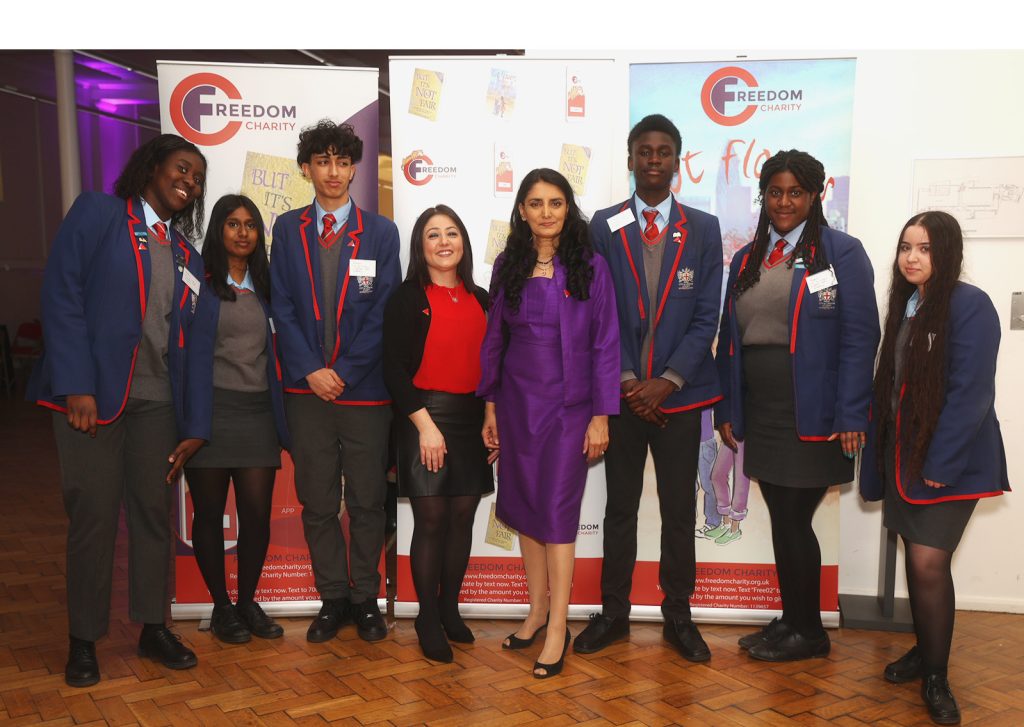
The campaign is already available on Freedom’s website. It will spotlight one decision each day from 25 November to 10 December 2026, while all 16 stories and explanations remain accessible throughout.
One question that changes the conversation
The opening scenario asks: Would you call her parents? It describes a pupil who fears she may be forced into marriage. The scenario is an educational illustration, not a claim about an identifiable survivor.
In most circumstances, speaking to parents about a child’s welfare may feel routine. Suspected forced marriage requires a different risk assessment. The UK government’s multi-agency forced marriage guidance warns that approaching family members can prompt them to move a child, accelerate travel or bring forward a marriage.
The lesson is not that professionals should improvise or make decisions alone. It is that they must recognise the particular risk, safeguard the person, seek appropriate specialist advice and follow the relevant statutory and organisational safeguarding procedures.
Sixteen practical decisions, not sixteen slogans
Visitors can turn each campaign card to reveal the issue, then read a fuller account of the safeguarding considerations and the action that may be needed. The questions cover recognising a disclosure, avoiding harmful assumptions, understanding FGM-related responsibilities, responding to digital control and recognising when apparently helpful intervention could cause further harm.
Three principles run through the campaign:
- Listen and assess risk. A disclosure should be taken seriously, without stereotyping individuals or communities.
- Do not alert potential perpetrators. Where forced marriage or related abuse is suspected, contacting family members or attempting mediation can increase risk; follow specialist guidance.
- Use established safeguarding routes. Keep the person’s immediate safety central and involve the responsible safeguarding, statutory or specialist services as appropriate.
These principles are educational signposts, not a substitute for professional case-by-case judgement or current safeguarding guidance. The campaign links readers to relevant government and specialist sources.
Why the campaign has a place in 16 Days of Activism
The international 16 Days of Activism movement draws attention to violence against women and girls. Freedom’s contribution focuses on a question that can be overlooked in awareness campaigns: what happens after somebody recognises that a person may be at risk?
Instead of simply asking people to condemn abuse, the series invites schools, community organisations, employers and the wider public to consider the consequences of an actual safeguarding choice. Freedom Charity is running the initiative independently; it does not claim United Nations endorsement.
Explore the campaign and contact Freedom
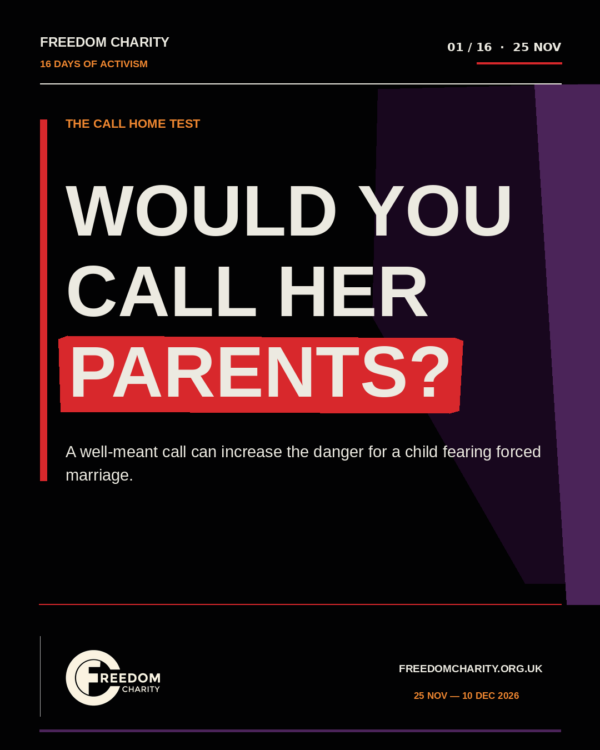
Read all 16 safeguarding decisions and turn the interactive cards. The page also provides guidance, further sources and options to support Freedom’s prevention and education work.
Journalists and producers can find background information, original archive materials and an interview enquiry route through Freedom Charity’s media centre.
Safeguarding: Anyone concerned about their own safety or someone else’s should use appropriate professional, statutory or specialist support. Freedom’s helpline page explains its service and signposting. In an immediate emergency in the UK, call 999.
Dishonour Abuse: What the 2026 Police Figures Miss
New Home Office statistics published on 5 November 2026 record 3,145 offences flagged by police as related to so-called “honour-based” abuse in England and Wales in the year ending March 2026. The figures demand attention. But they must not be mistaken for the true scale of abuse.
What the latest official figures show
- 3,145 police-recorded offences flagged as related to so-called “honour-based” abuse, compared with 2,949 the previous year (a 7% increase).
- 166 recorded female genital mutilation (FGM) offences, compared with 109 the previous year. Of the 166, 85 followed referrals under the FGM mandatory reporting duty.
- 129 recorded forced marriage offences, compared with 125 the previous year.
- 22% of flagged offences were recorded as controlling or coercive behaviour; 14% as assault with injury.
These are offences recorded by police, not a count of individual victims. A single person may experience multiple offences, while many people subjected to abuse never report it.
What the figures cannot tell us
The Home Office explicitly warns that these statistics are not a reliable measure of prevalence or of changes in the underlying level of abuse. Reporting, police training, recognition and the application of crime-recording flags all affect the totals. Changes to the Metropolitan Police’s recording system have also affected national figures.
It would therefore be misleading to claim that FGM itself rose by 52%, or that the overall number of people experiencing this abuse rose by 7%. What increased was the number of recorded offences in the relevant categories. The rise in FGM records is significant enough to examine, but the Home Office cautions that comparatively small annual totals can fluctuate.
Why Freedom Charity calls it Dishonour Abuse
The Home Office and Crown Prosecution Service use the term “honour-based” abuse in official statistics and guidance. Freedom Charity uses Dishonour Abuse to challenge the suggestion that controlling, threatening or harming another person can ever confer honour. We retain the official terminology when identifying government data so that readers, researchers and professionals can locate and compare the source accurately.
These crimes can involve threats, surveillance, isolation, coercive control, physical and sexual violence, forced marriage and FGM. Risk may come from more than one person, including family or wider networks. Safeguarding responses must consider that wider context rather than assuming a single perpetrator.
The safeguarding question behind the numbers
The most important question is not simply whether a national total has risen. It is whether a child or adult at risk can disclose abuse safely, be believed, and receive a coordinated response before harm escalates.
Professionals should consider the possibility of multiple perpetrators, threats linked to travel or marriage, restrictions on communication, and the risk that contacting relatives could increase danger. Any response must follow current safeguarding procedures and be tailored to the individual circumstances. Where there is immediate danger, call 999.
What should happen next?
Freedom Charity calls for better recognition of coercion and family-network abuse, consistent recording, appropriate training and safe routes to specialist support. These are policy recommendations, not conclusions proven by the statistical release. Better data must be matched by better protection.
For further context, read Freedom Charity’s Forced Marriage Unit statistics and explanation of Dishonour Abuse. The Forced Marriage Unit’s assistance statistics and police-recorded offence figures describe different things and must not be added together.
Primary sources
- Home Office: Statistics on so-called ‘honour-based’ abuse offences, year ending March 2026 (5 November 2026).
- Crown Prosecution Service: ‘Honour’-Based Abuse, Forced Marriage and Harmful Practices — prosecution guidance.
Analysis by Freedom Charity. Official figures are attributed to the Home Office. Published 6 November 2026.
Freedom Founder Nominated for INSPIRE Award
Freedom Charity founder Aneeta Prem MBE has been nominated for the 2027 Multicultural INSPIRE Awards in the Outstanding Contribution to Social Change category. Her nomination reflects her work through Freedom Charity to prevent forced marriage, female genital mutilation (FGM), Dishonour Abuse and other forms of violence against women and girls.
We would be grateful for your vote. Vote for Aneeta Prem MBE on the official INSPIRE Awards website before 12 noon on Monday 26 October 2026. Find her under Outstanding Contribution to Social Change.
What are the Multicultural INSPIRE Awards?
The Multicultural INSPIRE Awards celebrate individuals and organisations making a positive difference in British society, including people from communities whose achievements do not always receive the attention they deserve. The Outstanding Contribution to Social Change award recognises contributions to issues including equality, justice and human rights.
The 2027 awards ceremony will take place in Birmingham on 13 February 2027. Aneeta is a nominee, not yet a finalist. Public voting contributes to selecting finalists; winners are chosen later by an independent judging committee.
Why Freedom Charity’s work matters
Founded in 2009, Freedom Charity challenges abuse that takes away someone’s safety, freedom and right to choose. Education and prevention are at the heart of our work. We want young people to recognise warning signs, understand their rights and know where to seek help.
Through books, school resources, safeguarding education, training and awareness campaigns, we have worked to make subjects such as forced marriage and FGM easier to recognise and discuss. Aneeta’s official nomination also refers to her contributions to parliamentary discussions and her books But It’s Not Fair and Cut Flowers.
There is no honour in abuse. No tradition, family expectation or reputation can justify coercion, threats or violence. That is why Freedom uses the term Dishonour Abuse.
What this recognition could mean
Recognition is only valuable if it helps bring these issues to wider attention. We hope the nomination will introduce more people to Freedom’s safeguarding work, encourage difficult conversations and help schools, families and professionals recognise abuse and take it seriously.
We are grateful to our trustees, volunteers and supporters, and especially to those who have trusted Freedom. There is still much to do.
Please vote and share
If you would like to support this nomination, please vote for Aneeta Prem MBE in the Outstanding Contribution to Social Change category and share the link with family, friends and colleagues.
Voting closes at 12 noon on Monday 26 October 2026. Thank you for supporting Freedom Charity.